
For decades, the prevailing wisdom in the United States has been that innovation is enough. As long as we’re inventing the next big thing, the thinking goes, it doesn’t matter where it’s made. But according to Liz Reynolds and Chris Love, two leading manufacturing experts from MIT, that approach is no longer sufficient — not for our economy, and not for our national security.
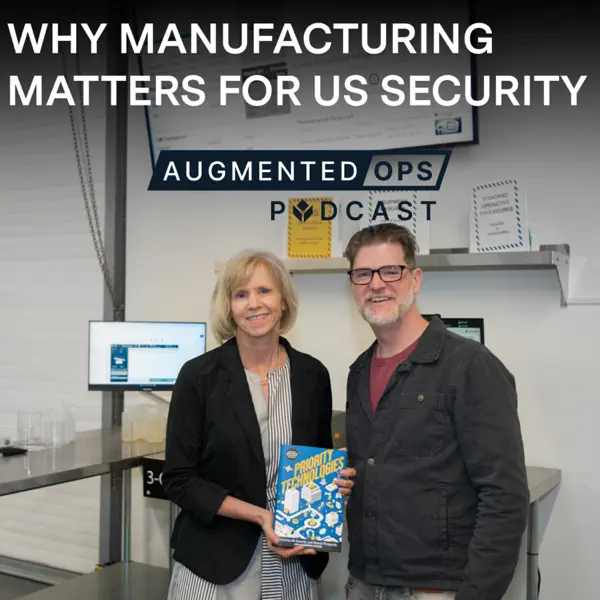
In a recent episode of the Augmented Ops podcast, Reynolds and Love sat down to discuss their new book, “Priority Technologies: Ensuring U.S. Security and Shared Prosperity.” The book, which covers six key areas from critical minerals to advanced manufacturing, argues that the United States is facing an industrialization problem — and that solving it will require a fundamental rethinking of how we bring new technologies to market.
“The United States no longer has an invention problem,” Reynolds said. “We’re the best in the world at invention today. But what we have is an industrialization problem. We don’t understand how to bring some of these ideas quickly into the marketplace to test them out and to advance the underlying technologies that are a part of that.”
Innovation just for innovation’s sake is not enough. Unless we see the benefits of innovation being shared broadly, we have pushback — and understandably so.
The stakes, the authors argue, could hardly be higher. Just 20 years ago, the United States led the world in 60 out of 64 key technologies. Today, we’re behind China in 57 out of 64. And while our innovation ecosystem has long been the envy of the world, it’s becoming increasingly clear that invention alone is not enough to ensure global leadership and competitiveness.
The solution, Reynolds and Love believe, lies in a renewed focus on manufacturing. For too long, they argue, the United States has allowed production to go offshore, losing not just jobs but also critical aspects of the innovation process itself. By bringing ideation and production closer together, they suggest, we can create a virtuous cycle of learning and iteration that will help us stay ahead of the curve.
One area where this convergence is already starting to take shape is in advanced manufacturing. Thanks to new technologies like software, AI, and automation, the authors note, it’s now possible to “shrink the factory” and enable more distributed forms of production. They point to examples like Sunflower Therapeutics, an MIT spinout that’s developing small-scale GMP production equipment for biopharmaceuticals, and micro-factories that can assemble iPhones at competitive costs.
But the potential benefits of this shift go far beyond any one industry or product. By lowering the barriers to entry for production, Reynolds and Love argue, we can create entire ecosystems of prosperity across the country — much like the craft brewing industry has done in recent years.
“Craft brewing is a great example,” Love said. “There’s something like 9,000 craft brewers now across the United States. It accounts for about 25% of beer volume sales. And while we’d like to make things that are maybe higher value-add, like medicines and other kinds of nutritional supplements, than just beer, it does have a really remarkable knock-on effect in the local economies.”
We’re at this moment in time where we can make manufacturing cool again. We’ve sort of forgotten as a country that manufacturing is actually a great thing. People like to make things.
Of course, realizing this vision will require more than just technological innovation. It will also require a renewed focus on workforce development, environmental sustainability, and the other enabling conditions that make manufacturing possible. But for Reynolds and Love, the imperative is clear: if the United States wants to maintain its global leadership in the years ahead, it needs to start making things again.
“I think we’re at this moment in time where we can make manufacturing cool again,” Love reflected. “With new innovations and technologies, these are things that help you make better. And this is really what automation, software, AI, robots — these ultimately allow us that co-working experience. It’s about making things, but doing it in a way that really is transformative, both for your family and for the larger ecosystem.”
In other words? It’s time to stop thinking of manufacturing as a problem to be solved, and start seeing it as an opportunity to be seized. The future of American innovation — and American security — may well depend on it.
To learn more about “Priority Technologies” and the critical role of manufacturing in America’s future, check out the full conversation with Liz Reynolds and Chris Love on the Augmented Ops podcast, available on LinkedIn, YouTube, and Tulip.co. And for more insights on the future of industrial innovation, don’t miss the MIT Initiative for New Manufacturing, a new effort to catalyze the transformation of U.S. production across sectors and regions.