
In the world of manufacturing, uptime is money and safety is paramount. So when a shiny new technology like autonomous mobile robots (AMRs) comes along, it’s natural for operations leaders to approach with caution.
Will these robots disrupt production? How will they navigate alongside human workers? What about security and data privacy? And perhaps most importantly, will they truly make life on the factory floor better, or just more complicated?
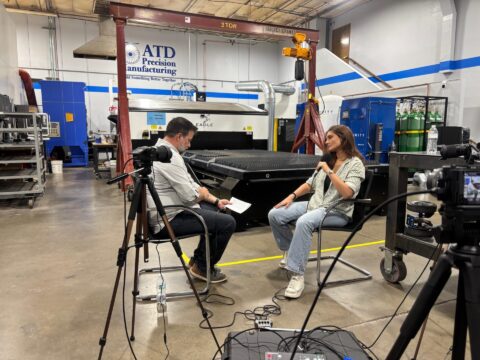
These are the questions that keep Crystal Mattich and Sherry Brown busy. As senior leaders at BrainCorp, a company at the forefront of bringing AI and robotics to real-world environments, they’ve guided manufacturers of all stripes through the process of AMR adoption. And on a recent episode of the Manufacturing Executive Podcast, they shared some hard-won wisdom about what it takes to get it right.
The first step, they argue, is understanding exactly what you’re dealing with. AMRs are not to be confused with the fixed industrial robots of yore, which are typically corralled behind cages and operate distinctly from human workers.
“Autonomous mobile robots are designed to be able to operate safely around humans without additional safeguarding equipment like cages or barriers or light curtains,” Brown explained. “So that takes adhering to the latest safety standards like the ISO 13482 for mobile robots or the ANSI/RIA R15.08 standard for mobile platforms.”
AMRs are designed to be able to operate safely around humans without additional safeguarding equipment like cages or barriers or light curtains.
In practice, that means AMRs come equipped with a host of sensors, obstacle detection capabilities, and controlled stopping functions that allow them to navigate dynamic environments without posing a danger to their human coworkers. But as Brown noted, not all AMRs are created equal on this front.
“When you’re evaluating partners, make sure you’re digging into their functional safety designs,” she advised. “What are the actual certifications that they have achieved, and has it been certified by a third party to those standards?”
Data security and privacy are another key consideration. As Mattich pointed out, robust data governance practices are table stakes for any reputable AMR provider.
“Ensuring there’s a secure development lifecycle — that’s one of the requirements of the SOC 2 Type 2 framework,” she said, referencing a common security certification in the software world. “What it means is the company, from onboarding to offboarding of people, their security at the product level, they have a security-first approach.”
Talk to the suppliers once you’ve identified the bottleneck, the problem you want to solve. Identify the suppliers that work in those spaces and then ask them about these things that we’ve covered so far in the podcast. What is their operational resilience? How is the technology able to handle sort of the real-world messiness of a real-world factory?
For manufacturers evaluating potential AMR partners, Mattich recommends looking for providers that are transparent about their data practices, with audit-ready artifacts and clear communication about where and how data is stored and used.
But even the most technically solid AMR solution will fail to deliver value if it doesn’t fit seamlessly into the realities of the factory floor. That’s why Brown advises manufacturers to start not with spec sheets and capabilities brochures, but with a hard look at their own operations.
“Step away from the shiny tech brochures and start with the specific problem that you want to solve,” she said. “What do you want the robots or the AI or the technology tool to do? Walk your production floor, look at your processes. Where do you have repetition? What’s predictable? What is operationally heavy? And then identify your bottleneck. That’s where this technology can help.”
The goal, she argued, is to find a solution that slots neatly into existing workflows and alleviates real pain points, rather than forcing teams to adapt to a whole new way of working.
Of course, even the most seamless technological integrations require some degree of change management. But Mattich and Brown maintain that when AMRs are deployed thoughtfully and with clear communication, the human-robot relationship tends to flourish.
“Autonomy is built on trust,” Mattich said. “With that trust established, that really is where we see the adoption of autonomous mobile robots.”
For manufacturers standing on the precipice of the AMR revolution, Brown offered this parting advice:
“When you select the technology that’s going to fit in your workflow, remove your bottlenecks, and you’ve done your operational due diligence of checking all these additional things beyond just the price, you’re going to see much better adoption in your workplace and really be able to get your team members on board with leveraging these tools to everybody’s benefit.”
In other words, the robots are ready whenever you are. Just be sure to look before you leap.
To learn more about BrainCorp’s approach to AMR safety, security, and deployment, visit braincorp.com and trustcenter.braincorp.com. You can also hear Crystal Mattich and Sherry Brown’s full conversation with host Joe Sullivan on the Manufacturing Executive Podcast.