
When James DeMuth set out to build walking robots for disaster recovery, he quickly realized he had a power problem. The quadrupedal bots his team was developing at Santa Clara University needed more juice than existing energy systems could provide.
That realization set DeMuth on a path that would ultimately lead him to the Lawrence Livermore National Laboratory, where he worked on laser-based fusion power — and discovered a new passion in the process.
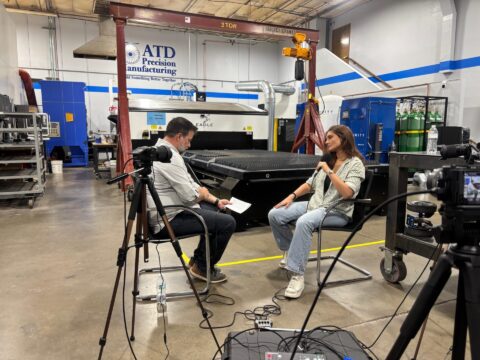
“We had lots of challenging problems as you could imagine, but a really big one was the fact that these are really large fusion chambers, and they need to be made out of a material that can fall apart by 450 million years,” DeMuth recalled on a recent episode of the Manufacturing Executive podcast. “So some farmer can dig it up in several thousand years and not get irradiated.”
The problem? The only material that fit the bill, an oxide dispersion strengthened steel, couldn’t be welded or cast. It could only be 3D-printed — a process that, at the time, was far too slow and expensive to produce the massive chambers required for fusion power plants.
Metal laser-powder bed fusion today has now been in the industry for over 30 years, right? It’s doing crazy stuff like printing rocket engines for space or printing medical hip implants, you name it. But it’s all relatively low volume, high-end use application type products. It’s not broken really into the high volume manufacturing space.
That realization set DeMuth and his co-founders on a mission to fundamentally reshape the economics of metal additive manufacturing. The result is Seurat Technologies, a startup that’s developed a new approach to 3D printing that it says can finally bring the technology into the realm of mass production.
At the heart of Seurat’s technology is a different way of fusing metal powder into solid parts. Traditional laser-based systems use a single beam to trace out each layer of a design, a time-consuming process that limits both speed and resolution.
Seurat’s system, by contrast, uses an array of over a million micro-mirrors to project an entire layer at once, each pixel representing a spot size of just 40 microns. The result, DeMuth says, is a process that’s not only 10 times faster than existing powder bed fusion technology, but also capable of producing parts with far greater precision and surface quality.
“Imagine subs that can move more quickly and silently than they ever could before,” DeMuth mused, pointing to propellers as one potential application. “Additive is really good at designs that merge more seamlessly with their environment.”
But Seurat’s ambitions extend far beyond propellers. The company is targeting a $3 trillion market for metal parts that cost $10 or more to produce — a market that’s growing at 10% per year. And with its technology, DeMuth believes Seurat can drive the cost of 3D-printed metal parts below $10 per kilogram, opening up a vast new realm of possibilities.
Selfishly, we can map out a path for how we get to less than $10 or a kilo. I mean, from a pure dollar per kilo perspective. There is an opportunity to take down that whole $3 trillion market and it’s growing 10% year on year. So every six to seven years is doubling.
Of course, realizing that vision will require more than just a technological breakthrough. DeMuth is candid about the need for public-private partnerships to level the playing field with countries like China, which is already deploying fleets of subsidized 3D printers at scale.
“If we look at our competitors globally, China’s deploying fleets of 3D printers, where they’re essentially subsidized capex that got cheap labor,” he noted. “And there’s no world where the West is going to compete with that and deliver parts at a lower cost using the same technological basis.”
For DeMuth, that means the US needs to either invest in scaling and subsidizing its own additive manufacturing capabilities — or develop a fundamentally different technological approach. With Seurat, he believes he’s doing the latter.
But he’s also quick to note that Seurat can’t go it alone. For the US to regain its edge in global manufacturing, DeMuth argues, it will take an ecosystem-wide effort — one that includes not just startups like his own, but established players, academic researchers, and government agencies as well.
“We want to see the ecosystem succeed and for that to happen, we need to see the rising tide float all boats,” he said. “And that’s how we’re ultimately going to expand beyond just competing in aerospace and defense to competing globally and manufacturing, which is ultimately that’s the bar that needs to be crossed the end of the day.”
It’s a bold vision — one that would have seemed far-fetched just a few years ago. But if Seurat can deliver on its promise of high-volume, low-cost metal 3D printing, it might just be the catalyst that ushers in a new era of American manufacturing dominance.
“This is an exciting time in the world today,” DeMuth said. “We’re really seeing a resurgence of manufacturing and a resurgence of so these advanced capabilities and interest to move that forward from both federal and private. And now we just need to make it happen.”
In other words? Game on.
To learn more about Seurat Technologies and its high-volume metal additive manufacturing technology, visit seurat.com or email info@seurat.com.