
When Tony Barlett, COO of Sumitomo Drive Technologies, wants to explain the company’s current warehouse automation project, he starts with a trip to Walmart.
“Traditionally, you get the list, get in your car, you go to Walmart, and you start hunting down the list, right?” he mused on a recent episode of the Manufacturing Happy Hour podcast. “Well, this automation project sort of flips the script and basically has everything coming to you.”
It’s a deceptively simple analogy for a staggeringly complex undertaking. At Sumitomo’s Virginia Distribution Center, the company is in the midst of installing an AutoStore system — a grid of self-driving robots that can retrieve and deliver goods to human operators at dizzying speeds.
For Sean Lambert, the operations project manager overseeing the effort, the benefits are clear. “We were able to take almost 30,000 square feet of material and put it inside of a 7,500-square-foot box,” he explained. “So this gives us the ability to grow our business without having to expand from a physical building standpoint.”
Main drivers is we’re a growing company and we’re running out of space. So the biggest benefit of the system that we chose is we were able to take, I mean, almost 30,000 square foot of material and put it inside of a 7,500 square foot box.
But the project isn’t just about doing more with less space. It’s about fundamentally reimagining the role of the warehouse worker in an age of automation.
Under the new system, goods are brought directly to material handlers, who can then dispatch them to manufacturing, assembly, or shipping via automated guided vehicles (AGVs). It’s a far cry from the miles of walking and hunting that typify traditional warehouse work.
Of course, any mention of automation inevitably raises concerns about job displacement. But Barlett is quick to emphasize that Sumitomo’s approach is about making jobs easier and more efficient, not eliminating them.
“Automation is still a scary word for a lot of people who have jobs impacted by automation,” he acknowledged. “Making sure that you communicate early and often and really make sure that they understand that the effort here in the spirit of this project is not to displace your job. It’s to make your job easier, and you can be more efficient.”
Ultimately, you got to jump in and do it because if you’re not doing this thing from an automation standpoint, you’re missing the boat because it is the wave of the future.
Looking ahead, both Barlett and Lambert see immense potential for artificial intelligence to further optimize warehouse operations. While the specific applications are still uncertain, they’re confident that the benefits will be significant.
In the meantime, they offered some hard-won advice for other manufacturers considering a similar leap. Start with the problem you’re trying to solve, whether it’s scaling without adding fixed costs or addressing labor shortages. Communicate early and often with your team about the impact of automation. And perhaps most importantly, plan for scalability.
That’s where the Lego analogy comes in. AutoStore’s modular design means that Sumitomo can add on to the system as their business grows, without starting from scratch.
“We’ve made this large investment obviously for now,” Barlett said. “But in five, six, seven, eight years, if we want to add on top of it, right? And do the exact same thing on top to support our business going forward is scalable.”
For manufacturers on the fence about automation, Barlett had one final piece of advice: just do it.
“Ultimately, you got to jump in and do it because if you’re not doing this thing from an automation standpoint, you’re missing the boat,” he urged. “This labor force shortages and issues with having people come into the labor force are not going away. It’s probably only going to get more difficult.”
In other words, the future of warehousing is here — and it looks a lot like a life-sized game of Legos. The only question is who will build it first.
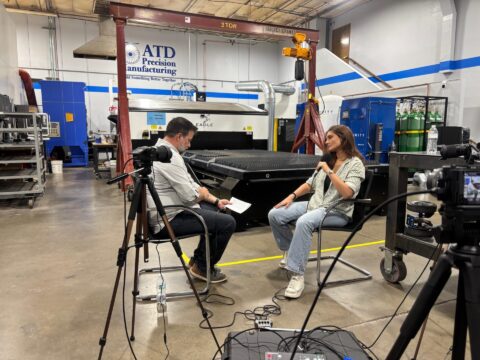
To learn more about Sumitomo Drive Technologies and their warehouse automation journey, visit [company website]. You can also hear Sean Lambert and Tony Barlett’s full conversation with host Chris Luecke on the Manufacturing Happy Hour podcast.