
When Beatriz Gutierrez talks about the future of American manufacturing, she doesn’t start with robots or AI or 3D printing. She starts with something far more fundamental: the power of regional ecosystems.
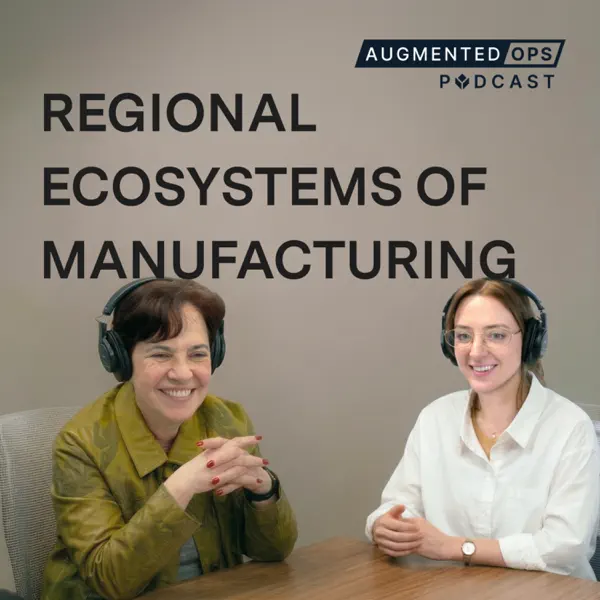
Gutierrez is the CEO and President of CONNSTEP, Connecticut’s Manufacturing Extension Partnership (MEP). In a recent episode of the Augmented Ops podcast, she made the case that these often-overlooked organizations are the unsung heroes of the industry’s resurgence.
“An MEP is basically a partner to a small and medium manufacturer,” Gutierrez explained. “It’s a program that is funded by federal money through NIST, which is the National Institute of Standards and Technology under the Department of Commerce.”
We act as consulting companies that help manufacturers find resources, develop skills, and basically leverage their knowledge and resources available to them to grow and create strong companies in each state and as part of a national ecosystem.
That ecosystem approach is key. While there are 51 MEP centers across the country — one in each state plus Puerto Rico — they’re not one-size-fits-all. Each adapts its offerings to the unique needs and strengths of the local market.
In Connecticut, that means a heavy focus on the aerospace, shipbuilding, and medical device supply chains. CONNSTEP works closely with major players like Raytheon, Electric Boat, and a host of smaller manufacturers to drive innovation, workforce development, and operational excellence.
And the impact is measurable. Gutierrez pointed to a standardized system that tracks jobs retained and created, cost savings, increased sales, and net promoter scores for each MEP engagement. Roll that up to the state level, and the numbers are striking.
“We are able to measure GDP contributions, job creation, state tax, federal tax,” she said. “When we do that, and we collect that information, we’re able to say that this program, for each dollar invested, we return around $2.69.”
What is very interesting is when you’re trying to take that and translate it into economic impact, we are able to measure GDP contributions, job creation, state tax, federal tax.
But it’s not just about the hard metrics. Gutierrez argued that the real value of the MEP model lies in its agility and responsiveness to changing industry needs.
When the pandemic hit and manufacturers faced a sudden labor crunch, CONNSTEP pivoted to programs focused on recruiting, training, and upskilling workers. They launched supervisor bootcamps, ramped up outreach to veterans, and collaborated with community colleges to develop targeted training programs.
Now, as the workforce ages and labor shortages persist, the focus is shifting again — this time, to automation and Industry 4.0 adoption. But Gutierrez cautioned that technology alone is not a silver bullet.
“First you find people, but if people are not going to be available or you are not able to do that at an economic point, one of the things we’re working very closely with other partners, including Connecticut Center for Advanced Technologies, is getting people ready to transition to 4.0,” she said. “For that, the ideal thing is improve your processes first and then bring technology. You don’t want to put technology on a bad process.”
That emphasis on fundamentals — on strategic planning, continuous improvement, and workforce development — is a common thread in CONNSTEP’s work. And it’s one that Gutierrez believes is critical to the future of manufacturing, in Connecticut and beyond.
For all the talk of a high-tech renaissance, she argued, the real key to the industry’s resurgence lies in something far more human: the grit and commitment of the small and medium manufacturers that form the backbone of regional ecosystems.
“These manufacturers are very committed, and I am very focused on small and medium — I’ve said up to 500 employees, that’s my area of work,” Gutierrez reflected. “A lot of these manufacturers are very invested in their companies because they’re invested in the community. They come from these towns, and they come from this company, so they want to succeed, and they want the economy to succeed — but not only for a personal benefit, but because they truly, companies have created community.”
In an era of global supply chain disruptions and rapid technological change, that kind of local rootedness and resilience may be the ultimate competitive advantage. And if Gutierrez and her fellow MEP leaders have their way, it’s one that will keep American manufacturing strong for generations to come.
“I am very optimistic about the thinking, the innovation,” she said. “I do think from the standpoint of global diversity, being able to connect at all levels, the technology allows us today to make connections with people in Germany or in India. I think that’s an engine of knowledge, and an engine of creativity. And I’m really hopeful that continues.”
To learn more about CONNSTEP and its work supporting Connecticut manufacturers, visit connstep.org. For more insights from Beatriz Gutierrez and other industry leaders, check out the Augmented Ops podcast, available on LinkedIn, YouTube, and tulip.co/podcast.