
When we talk about the future of manufacturing, it’s easy to get caught up in visions of lights-out factories and robots that never sleep. But as a recent episode of the Advanced Manufacturing Now podcast made clear, the real revolution isn’t about replacing humans — it’s about empowering them.
“It’s definitely an important space to keep an eye on,” noted Amy Bryson, one of the podcast’s hosts and a regular contributor to Manufacturing Engineering Magazine. “From large shops to small shops, it’s impacting everyone.”
The “it” in question? Artificial intelligence, or AI. As Bryson and her co-hosts Steve Plum and Kip Hansen discussed, AI is rapidly changing the face of manufacturing, from the way we design products to the way we optimize processes on the shop floor.
But rather than rendering human workers obsolete, the rise of AI is actually making their role more critical than ever. The key, the hosts argued, is to think of AI not as a replacement for human intelligence, but as a tool to augment and enhance it.
The trick is to teach AI what you need it to do. It’s good at remembering things like that. I mean, the days of it hallucinating like crazy are gone, it still does make mistakes from time to time. But you’ve got to embrace it.
That embrace is already well underway in the world of press brakes, where Hansen noted that manufacturers are increasingly turning to advanced tooling and clamping systems to reduce setup times and increase flexibility for high-mix, low-volume production.
It’s a similar story in the world of chip removal, where new cutting tool materials like CBN and PCD are enabling higher surface speeds and more complex geometries — but also creating new challenges in chip control and coolant recovery.
“George [Georgiou] and LNS North America also offered good advice on new ways to dispose of chips, including compaction processes that squeeze out coolant,” Plum noted. “It’s been a while, I know, since you’ve worked in the shop, but how much have things changed in regards to chip removal from when you started out, Kip?”
Hansen’s answer? A lot — not just in the technology itself, but in how it is being applied to solve real-world manufacturing challenges.
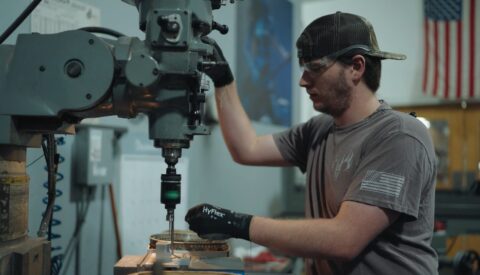
I think it’s changed a lot, now, whether shops are taking advantage of all the technology that’s out there is up for debate, but I still remember back probably 1985, 1986, we got our first true CNC lathe. And at that point, we were doing hand-sharpened tool bits a lot of the time.
Fast forward to today, and the landscape looks very different. From AI-powered toolpath optimization and simulation to real-time machine monitoring and predictive maintenance, the tools available to manufacturers are more sophisticated than ever before.
But as Bryson pointed out, those tools are only as valuable as the human insights that guide them. That’s where initiatives like Manufacturing USA come in — a network of 17 institutes across the country that are working to bridge the gap between cutting-edge research and real-world industrial applications.
“The institutes like to think of themselves as conveners of businesses, even competitors, and academic institutions and other stakeholders to test applications of new technology, advanced technology, create new products, and help manufacturers reduce cost and risk and really scale,” Bryson explained.
The goal? To ensure that the innovations born in American research labs can be successfully commercialized and produced on American soil. And while the institutes span a wide range of focus areas, from smart manufacturing to advanced composites to hybrid electronics, they all share a common vision of a manufacturing future that puts humans at the center. So what does that future look like in practice? According to the hosts, it’s one where AI and automation are powerful tools in the hands of skilled human operators — not substitutes for them.
It’s a future where advanced materials and processing techniques enable new levels of flexibility and customization, but where the knowledge and expertise of seasoned machinists and engineers are more critical than ever.
And it’s a future where the success of American manufacturing doesn’t hinge on chasing the lowest labor costs or the highest output volumes, but on leveraging the creativity, adaptability, and problem-solving skills of its workforce.
“A lot of opportunities there,” Hansen mused as the conversation turned to the technologies that are already transforming shop floors across the country, from collaborative robots and pallet changers to multitasking machines and real-time machine monitoring.
The common thread? A recognition that even the most advanced technologies are only as valuable as the human insights that guide them — and that the real power of AI and automation lies not in replacing workers, but in empowering them to work smarter, faster, and better.
As Plum put it, “AI is going to help with that. AI is great at looking at this mountain of data that’s coming off the shop floor and making sense of it and looking for events that, that a human probably wouldn’t catch, and even if they had time to look for them, they probably wouldn’t catch.”
In other words? The future of manufacturing is human-centered — and AI-powered. And for the hosts of Advanced Manufacturing Now, that’s a recipe for success that’s as exciting as it is inevitable.
“I thought there was a really fun article to write, and it was great to circle back with a lot of these folks that have given us meaningful and helpful input over the past year or so,” Hansen reflected.
We couldn’t agree more. Here’s to the next chapter in the ever-evolving story of American manufacturing — and to the humans and machines that will write it together.
For more insights on the future of manufacturing, be sure to check out the full episode of Advanced Manufacturing Now, available on [wherever you get your podcasts]. And for the latest news and analysis from the world of manufacturing, visit AdvancedManufacturing.org.