
When Annie Lu looks at the world of manufacturing, she sees a sector ripe for disruption. As the co-founder and CEO of Laminar, a physical AI company pioneering the concept of “process-aware autonomy” for self-driving factories, Lu has made it her mission to challenge the conventional wisdom that has held the industry back for decades.
“At Laminar, we are a physical AI company, and we are pioneering this term we coined called process-aware autonomy to enable self-driving factories,” Lu explained on a recent episode of the Manufacturing Executive podcast. “What does that mean? Self-driving factories are factories with production lines that continuously optimize and heal themselves automatically.”
It’s a bold vision — one that Lu and her brother David, with whom she co-founded the company, have been working towards since their earliest days growing up on factory floors. As part of a generational manufacturing family, the Lu siblings gained a deep appreciation for the expertise and hard work that goes into running some of the world’s largest production facilities.
But they also saw firsthand the areas where innovation and improvement were sorely needed, particularly in process manufacturing, where a lack of visibility into what’s happening inside pipes and equipment has long been a major challenge.
“Something that was really particularly interesting about our exposure and experience growing up in specifically process manufacturing is we saw just directly in process manufacturing what’s different from discrete is that you can’t see what’s going on in the pipe,” Lu said. “There’s a fundamental lack of visibility because the entire operation is running through a pipe.”
And so when we started learning about this space, we actually asked a lot of the experts, is it possible to measure chemistry in pipes in real-time? And everyone told us it’s not possible. And I remember even as a child questioning that and thinking, well, why not? There must be a better way.
That questioning of the status quo has been at the heart of Laminar’s approach from the very beginning. By developing proprietary sensors that attach to pipes, equipment, and industrial infrastructure, the company has unlocked previously untapped data about the real-time chemistry and quality of what’s happening in a process line.
That data is then fed into AI models deployed on the factory floor, which compute real-time optimizations that are sent to the control system to ensure the operation is always running at peak quality, safety, and efficiency.
It’s a powerful concept — one that has already caught the attention of major players like Anheuser-Busch InBev and Danone, as well as mid-market manufacturers across a range of process industries. But as Lu is quick to point out, the real value of this kind of innovation comes not from isolated pilots, but from scaling it across an entire manufacturing footprint.
“The reality is, when we’re looking at manufacturing footprints of an industrial enterprise, where the value will really be achieved is if we scale innovation across the entire manufacturing footprint,” she said. “Because at that scale, it’s not about maybe in one line, you can drive one production line or one factory can drive marginal improvement, but really when we scale this across the entire manufacturing footprint, that right there is tens to hundreds of millions of dollars of savings and value being generated.”
We need to A, develop technologies that can be able to scale. There’s a lot of philosophy at Laminar, how we approach building the DNA of the product for the end user, where it’s very tangible use cases I mentioned earlier, but secondly, as well, something we see in our most successful partners who have really done this incredibly well is this mentality of we should not be coming in thinking, hey, like you just pilot in one line, pilot in one factory.
For manufacturers looking to embrace this kind of transformative change, Lu offers a simple but powerful piece of advice: adopt a “let’s make it happen” mentality. Rather than focusing on all the reasons an innovation project can’t work, she urges leaders to be agile, to implement quickly, and to capitalize on the momentum and appetite for change that exists in the industry today.
“Instead of, hey, these are all the reasons it can’t work, let’s think about how do you make it happen, right?” she said. “And the time we spend discussing whether we should do a project, by the time we finish discussing that, maybe our peers have already done and implemented the project, gotten the results, seen the success, and then scaled it at that point.”
It’s a mindset that has served Laminar well in its own journey to transform the manufacturing sector. And as Lu sees it, it’s one that will be essential for any company looking to stay ahead of the curve in the years ahead.
“I’m incredibly excited because there is so much momentum, there’s so much appetite, there’s so much value that has been driven in this industry,” she said. “And so just capitalizing that and scaling that is going to game change our entire manufacturing sector in America.”
For those ready to be part of that game-changing shift, the Laminar team is ready to help. Visit runlaminar.com or find them on LinkedIn to learn more about how process-aware autonomy can transform your operation — and to join the ranks of the manufacturing mavericks who are challenging the status quo and winning.
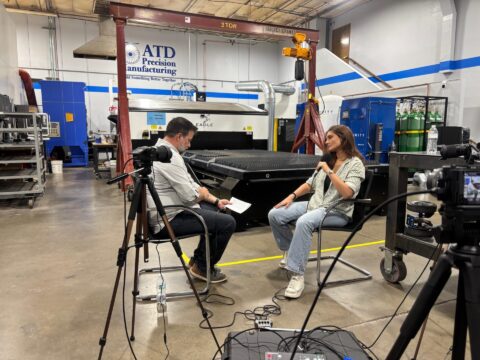
To hear Annie Lu’s full conversation with Manufacturing Executive host Joe Sullivan, check out the latest episode of the podcast, available on [your favorite podcast platform]. And for more insights into the future of manufacturing innovation, be sure to subscribe to the show and never miss an episode.