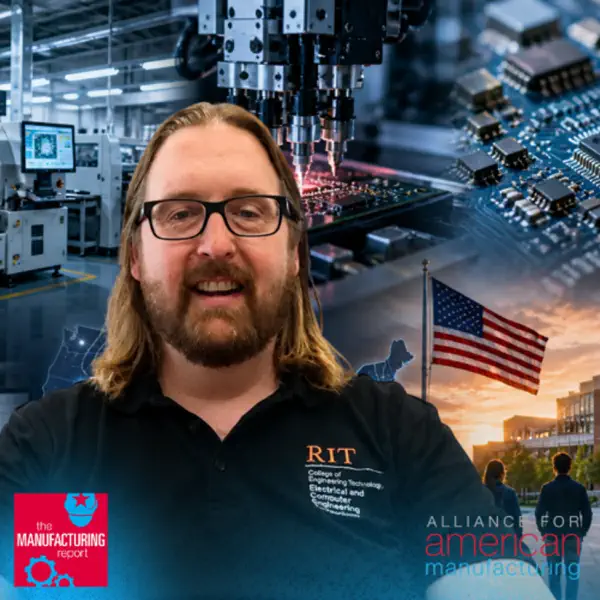

When Dr. Martin Anselm looks at the state of American manufacturing, he sees two things: a looming workforce crisis and an untapped pool of talent that could be the key to solving it.
As the director of the Center for Electronics Manufacturing and Assembly (CEMA) at the Rochester Institute of Technology, Anselm has spent his career at the intersection of advanced manufacturing, workforce development, and supporting America’s veterans. And what he’s learned is that when it comes to filling the skilled labor gaps that threaten the future of the industry, veterans are a natural fit — if only more manufacturers knew where to look.
“The people that we support here in Rochester, I’ve done it now three other times,” Anselm said on a recent episode of The Manufacturing Report podcast, referring to CEMA’s intensive four-week training program that prepares veterans for careers in electronics and semiconductor-related manufacturing. “It’s a very vibrant group, people that really want to learn. They questioned everything that I present, far more than any student does in any of my classes, which is a lot of fun.”
Someone who comes in as a technician with no college degree might become like a line manager or a shift manager. This is a career that they can get a 401k and move up in, even though they may not have an engineering degree, but they may functionally be an engineer after 10 years.
The program, which is funded by a $1 million grant from the state of New York, aims to connect veterans to jobs in circuit board assembly for everything from medical devices to defense systems — jobs that are facing a real workforce crunch as experienced technicians retire.
And while the technical skills are important, Anselm says it’s the soft skills that veterans bring to the table that really set them apart: their strong work ethic, their ability to follow instructions and troubleshoot problems, and their diversity of backgrounds and skill sets.
“I hope to continue to bring somebody who may have been on the street, recovering alcoholic or drug addict, that neither the career and the job, and tell their story,” Anselm said of the program’s track record of success.
But for all the promise that veterans hold for the future of manufacturing, Anselm is quick to point out that the industry still has work to do to make those careers accessible and attractive. Too often, he says, the path into manufacturing is seen as a binary choice between a four-year degree and a dead-end job — with little in between.
That’s where programs like CEMA’s come in. By offering short-term, intensive training that leads directly to jobs, Anselm and his team are working to create a new kind of career pathway — one that’s accessible to veterans and other nontraditional candidates, and that offers real opportunities for advancement and growth.
It’s probably one of only maybe a dozen universities around the country that has anything even close to what I have. The students in the Mechanical Engineering Technologies program have the opportunity to take a class and learn about the equipment, learn about the electronics manufacturing industry.
Of course, Anselm is quick to point out that CEMA’s program is just one small piece of a much larger puzzle. To truly solve the workforce challenges facing American manufacturing, he says, will require a concerted effort from industry, government, and educational institutions alike.
But he’s also optimistic about the future. With new investments pouring into semiconductor manufacturing across upstate New York — from Micron’s $100 billion fab in Syracuse to GlobalFoundries’ $1 billion expansion in Malta — Anselm sees a chance not just to rebuild the region’s industrial base, but to create a new generation of advanced manufacturing careers.
“We have to carve out parts of that that are being done in the United States for many different reasons,” he said of the multi-trillion dollar global electronics industry. “Here at RIT, we’re just trying to contribute to a little bit of that.”
And if Anselm has his way, it’s a contribution that will be measured not just in the number of circuit boards produced or the dollars invested, but in the lives transformed — of the veterans who find new purpose and prosperity on the factory floor, and of the communities that are rebuilt in the process.
“It’s a very fulfilling work,” he said of the program. “And I’m really excited to be able to support our local veterans here again to do this training.”
For those veterans — and for the future of American manufacturing — it’s an excitement that’s more than warranted. Because if there’s one thing that Anselm’s career has taught him, it’s that sometimes the most unlikely recruits can be the ones who make all the difference.
To learn more about the Center for Electronics Manufacturing and Assembly’s veteran training program, visit rit.edu/cema. And for more insights on the future of American manufacturing, tune into The Manufacturing Report podcast, available on Apple Podcasts, Spotify, or wherever you get your podcasts.