
When Dr. Maya Gupta decided to start a business, she didn’t follow the typical Silicon Valley playbook. There were no venture capitalists, no app developers, no dreams of becoming the next unicorn startup.
Instead, the longtime academic bought a laser cutter and started making jigsaw puzzles — by hand, out of wood, in America.
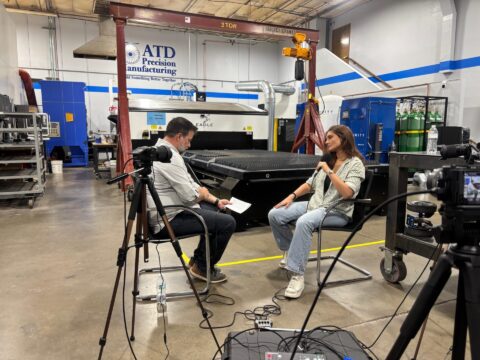
“In order to start a big tech business of some sort, I would need venture capitalist funding,” Gupta explained on a recent episode of The Manufacturing Report podcast. “And I had friends who had gotten venture capitalist funding, but I didn’t have the confidence to do that. I don’t want to go take five million of someone else’s money. I don’t know what I’m doing.”
I needed some real world experience. So I started this Artifact Puzzle really just to get some experience. 80% of businesses fail pretty fast. I mean, it’s really hard to get a successful business. That takes a lot of luck, but I got lucky in this case.
That luck — combined with a whole lot of skill, creativity, and old-fashioned hard work — has turned Artifact Puzzles into a true American manufacturing success story. Since its founding in 2007, the company has gained a loyal following among puzzle enthusiasts for its intricate, laser-cut designs and whimsical, art-inspired pieces.
“We make jigsaw puzzles, and we make some of the most awesome jigsaw puzzles in the history of the universe,” Gupta said with a laugh. “So we’re pretty proud of that, and that’s kind of our goal to keep doing.”
Unlike the mass-manufactured cardboard puzzles found in most toy stores, Artifact’s creations are anything but ordinary. Each one is cut from premium plywood using a custom laser cutter, resulting in pieces that are as unique as the images they depict.
“I think most people are used to jigsaw puzzles being made out of cardboard and these square pieces with knob connectors,” Gupta explained. “But jigsaw puzzles weren’t always that way. That was a change. Originally, they were hand-cut from wood, and if you’re sitting there hand-cutting a jigsaw puzzle with a jigsaw, you’re making these crazy irregular pieces and interesting shapes.”
We now have laser cutters, and we can now do incredibly amazing things and cut puzzle pieces, however we want, again, out of a beautiful thick wood for people.
That focus on craftsmanship and artistry is evident in every Artifact puzzle, from the 100-piece beginner sets to the massive 2,000-piece behemoths. Gupta and her team spend hours poring over each image, looking for opportunities to create pieces that are both visually striking and thematically appropriate.
A recent Greek mythology-inspired puzzle, for example, features pieces shaped like gods, minotaurs, and even a miniature Trojan horse. The result is a puzzle that’s as much a work of art as it is a brain teaser — and that’s exactly the point.
“We barely have any puzzles with square pieces,” Gupta said. “We’re just always trying to create interesting ways for pieces to connect and interesting piece shapes.”
Of course, creating puzzles of that caliber requires a special kind of workforce — one that Gupta has been able to cultivate thanks to Artifact’s commitment to American manufacturing. While the company started in Silicon Valley, it has since relocated to the small town of Port Townsend, Washington, where it employs a team of highly skilled artists and craftspeople.
“One of the things I love about us making our puzzles in America is that we get to hire really great people,” Gupta said. “And we hire a lot of artists or people who study art in college. And about 90% of our workforce does have college degrees, because we just need people who can handle a lot of complexity.”
That complexity extends beyond just the puzzles themselves. Because Artifact manufactures all of its products in-house, it’s able to offer a level of customer service that’s virtually unheard of in the puzzle industry.
If a piece goes missing or gets chewed up by an overenthusiastic puppy (a surprisingly common problem, Gupta notes), the company can simply laser-cut a replacement and ship it out in a matter of days. Try doing that with a mass-produced cardboard puzzle from overseas.
For Gupta, that ability to connect directly with customers and solve their problems is one of the most rewarding parts of running a made-in-America business. But it’s also a testament to the kind of quality and craftsmanship that’s all too rare in today’s fast-moving, disposable culture.
“Because we’re manufacturing and designing, we can just do a much better job at customer service,” she said. “And in particular, one of the things that can go wrong with a jigsaw puzzle, especially these heirloom quality puzzles that you’re going to have for years, is that a piece goes missing.”
It’s a small thing, perhaps. But in an era where so much of what we buy is designed to be used and tossed aside, there’s something deeply satisfying about a product that’s built to last — and a company that stands behind it every step of the way.
For Gupta, that’s the true joy of Artifact Puzzles. Not just the thrill of watching a beautiful image come together piece by painstaking piece, but the knowledge that each one is a little slice of American ingenuity and craftsmanship.
“It’s been fairly easy to be like, ‘ You want to move to Port Townsend? It looks beautiful,” she said of the company’s unlikely home base. “And so that’s been a fun way to get a lot of young, talented people into our workforce who already know a lot about art skills and art making.”
In other words? When it comes to American manufacturing, sometimes the best way to think outside the box is to start with a really good puzzle.
To see more of Artifact Puzzles’ exquisite designs — and maybe snag one for your own collection — visit artifactpuzzles.com. You can also hear Dr. Maya Gupta’s full conversation with host Scott Paul on The Manufacturing Report podcast, available on Apple Podcasts, Spotify, or wherever you get your podcasts.