
When Mae Krier turned 100 on March 21st — fittingly, National Rosie the Riveter Day — her mailbox was flooded with over 500 birthday cards. They came from people she’d met over her decades of tireless advocacy for the women who helped win World War II on the home front. They came from strangers who’d heard her story and felt compelled to reach out. And they keep coming, every single day.
“If they had the time to sit down and send me a card, I should have to sit down and read what they’ve written, which I did, every one,” Krier recounted on a recent episode of the Advanced Manufacturing Now podcast. “I’m posting my thank you, some of the cute quotes that people made, and some of the stories they told about their grandfathers or fathers or mothers. It’s just so amazing.”
Up until 1941, it was the man’s world. They didn’t know how capable American women were… Hitler, he said that he wouldn’t have any trouble defeating America because American women couldn’t produce. He said we’re soft and spoiled and spent too much time on cosmetic stuff and frivolous things. We showed him what American women were made of.
Krier knows a thing or two about amazing stories. At 17, she went to work for Boeing in Seattle, riveting B-17 and B-29 bombers as part of the war effort. She embodied the iconic “We Can Do It!” spirit that came to symbolize the Rosies — the women who stepped into factories, farms, and all manner of “men’s jobs” to keep the country running while their husbands, brothers, and sons fought overseas.
In the decades since, Krier has made it her mission to ensure that the Rosies’ contributions are never forgotten. She helped enact National Rosie the Riveter Day in 2017, and accepted the Congressional Gold Medal on behalf of all Rosies in 2022. She’s the subject of a children’s book, “We Can Do It!,” and hosts her own podcast, “Breaking Barriers with Mae Krier.” During the pandemic, she sewed thousands of Rosie-themed face masks and bandanas — one of which even made it to the International Space Station.
But for all the accolades, Krier is quick to emphasize that the Rosies’ story is far from over. She’s on a mission to build a monument in their honor on the National Mall in Washington, D.C., and she’s not about to let a little thing like turning 100 slow her down.
“All I can do is help provide and promote,” she said of the monument effort. “I’m more than willing; that’s up to them. This is their program, not mine, but I’m there for it 100%.”
It wasn’t fair that they didn’t recognize us women. When the war was over, the men came home, they got benefits. Women were just totally ignored. We got a pink slip, we were out the door. But the men got the G.I. Bill, they got different benefits, which they should — we don’t want to take that away from them at all. But there was never any mention of what we did, our role in all of this.
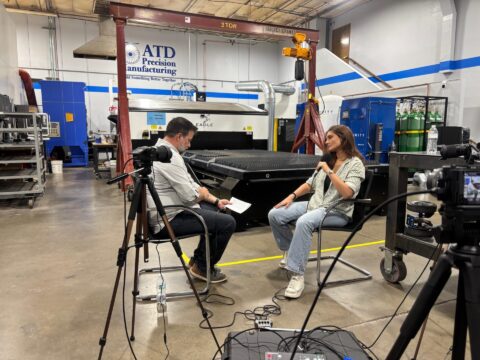
Joining Krier on the podcast was Ryan Kenny, a recent college graduate who works on Capitol Hill and has traveled the world with the centenarian Rosie. Kenny is part of the next generation taking up the torch, working to raise funds for the monument and encourage people to collect the stories of the Rosies in their own families before it’s too late.
“Traveling with Miss Mae Krier felt like I was traveling with Miss Taylor Swift,” Kenny laughed. “Everybody wanted to shake her hand and to be near her. Even though they called her name and they were chanting and cheering, I felt like a celebrity just by being in Mae’s proximity. It was unbelievable.”
For Krier, that’s what it’s all about: ensuring that the Rosies’ legacy lives on, not just in monuments and museums, but in the hearts and minds of generations to come.
“We women were never allowed to drive a taxi before,” she mused. “And of course they needed them. There are just so many different stories of different women that picked up on different jobs. That’s what the monument is all about.”
As for what’s next? Krier shows no signs of slowing down. She’s still sewing, still advocating, still riveting the world with her story.
“People like you help us promote this, help us gain ground,” she told host Steve Plum as the conversation drew to a close. “Ryan has a lot of work. She needs money just to survive until we get it done, am I right, Ryan?”
“Yes, we need much support,” Kenny agreed.
But with Mae Krier in their corner, something tells us the Rosies won’t have to wait much longer for their place in the sun.
To learn more about Mae Krier’s incredible life and legacy, check out her children’s book, “We Can Do It!”, or listen to her podcast, “Breaking Mid Barriers with Mae Krier” — available on all major platforms. To donate to the Rosie the Riveter Monument, visit www.WorldWarTwoWomenMemorial.org.