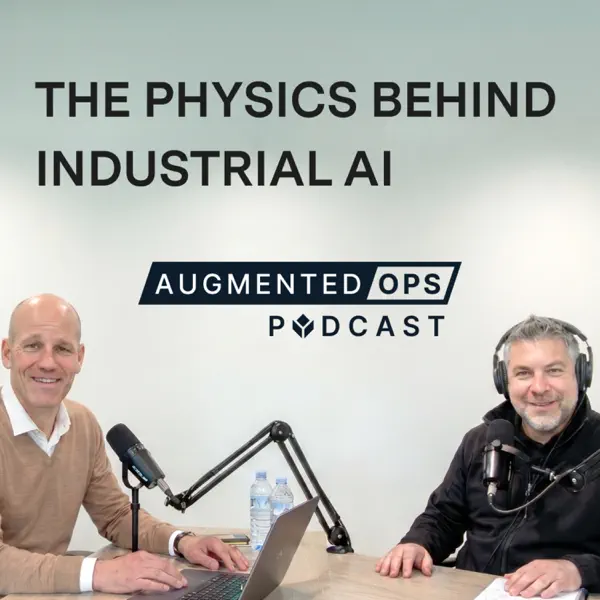

When we think about the potential of artificial intelligence to transform industry, it’s easy to get caught up in the hype around machine learning algorithms and massive datasets. But according to Thomas Laurent, co-founder of X-Lost, we’re missing a critical piece of the puzzle: physics.
“We’ve had our brain as a species for like 600,000 years,” Laurent noted on a recent episode of the Augmented Ops podcast. “We’ve only started to build good bridges 2,000 years ago, even 200 years ago, because we needed to have the models and the physics in order to do it. So that’s what the physics brings to AI. It’s like everything we’ve built, we’ve built not because we had our brain, but because we had the physics.”
“Physics-based structural performance management actually really helps… We understand that steel, with structural performance measurement, better than any time before.”
For Laurent and his team at X-Lost, that physics-based approach is the key to unlocking trillion-dollar opportunities in the industrial world. The company, which Laurent co-founded in 2012 and incorporated in Switzerland, focuses on what it calls “structural performance management” — essentially, using physics-based models to understand the real-time fatigue and remaining life of critical assets like airplane parts and oil rigs.
It’s a capability that Laurent argues is sorely lacking in many industries today. He points to the energy sector, where X-Lost works with big kit like floating barges and downstream plants, as a prime example.
“People fill up at the pump, and they think it’s all easy, right?” he said. “But we now realize over the past couple of months that it’s not. It’s actually very hard to get this oil in your tank. What that industry has done very well is actually build huge plants which produce very reliably and sweat the steel as much as it can.”
By combining physics-based models with AI and machine learning, Laurent believes companies can optimize that “steel sweating” process even further — enabling them to push assets to their limits safely and efficiently.
But realizing that vision will require a fundamental shift in how industries approach data sharing. Laurent points to the electronics industry, with its platform-based model for exchanging information between manufacturers, as a positive example. In contrast, he argues, the mechanical world is “shooting itself in the foot” by hoarding data within silos.
I think where we would have had that is when we go on the design side, for example, in the offshore wind industry. Everything in offshore wind is over-designed to a ridiculous extent… And for this, if they were able to share the data more between the blade manufacturer, turbine manufacturer, even within the turbine manufacturer, the blade division doesn’t share the data with the rest of the company. That is all costing in the end in capex and that’s making an industry less competitive.
Looking ahead, Laurent sees cause for optimism in the energy industry’s growing focus on resilience and diversification. He predicts a future where consumers and voters are more conscious of where their energy comes from, driving investments in decentralized infrastructure and redundant supply lines.
But he also offers a provocative prediction about the future of AI itself. As algorithmic efficiency improves, he suggests, we may see a shift away from the large language models that have dominated recent headlines and toward smaller, more targeted approaches.
“I think algorithmic efficiency, exactly the kind of algorithmic efficiency we brought to mechanical simulation, I think that’s going to kick in also on the AI side,” Laurent said. “So we’re going to move away from LLMs to small language models in many cases… This is a far prediction, but if it happens, what we’re going to see is that there’s going to have been an over-investment into all that computing ability because the algorithm will catch up in a way which is surprising and very powerful.”
In other words? The trillion-dollar equation for industrial transformation may not be quite as simple as “more data + bigger models = better results.” Instead, it may be something more like “targeted data + physics-based models + algorithmic efficiency = exponential impact.”
Or, as Laurent puts it: “We’re going to be able to run AIs much more cheap than we think.”
Either way, one thing seems clear: the physics layer is about to get a whole lot more interesting — and a whole lot more valuable.
To learn more about X-Lost and its physics-based approach to structural performance management, visit x-lost.com.