
When you think of precision manufacturing, you probably picture rows of high-tech machines churning out perfect parts with robotic precision. And you wouldn’t be wrong — but you’d be missing a critical part of the story.
Because as it turns out, even in the age of automation and artificial intelligence, some things still require a distinctly human touch. Call it intuition, call it feel, call it the art of manufacturing — whatever you call it, it’s the X-factor that separates the good from the great.
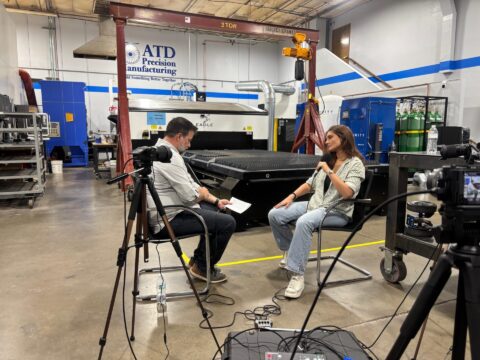
That was the key takeaway from a recent live taping of the Manufacturing Happy Hour podcast, recorded at the Manufacturing Exchange event in Rochester, New York. Hosted in collaboration with on-demand digital manufacturing powerhouse Fathom, the event brought together three industry leaders to discuss the state of the art in precision manufacturing.
And while the guests — Matthew Bradley of motion control specialist Moog, James Greer of rocket engine maker Crossbow Systems, and Chris Brown of Fathom itself — all came from different corners of the manufacturing world, they were united in their belief that humans remain the beating heart of even the most advanced production processes.
Take Moog, for example. As Bradley explained, the company routinely machines parts to tolerances measured in the millions of an inch — a level of precision that pushes the very limits of what’s possible with current technology.
“We get into parts that, you know, we’re machining down into the millions, right?” he said. “And trying to hold tolerances into the millions, which I guess you can argue, can you even measure that, right? We struggle with that ourselves sometimes.”
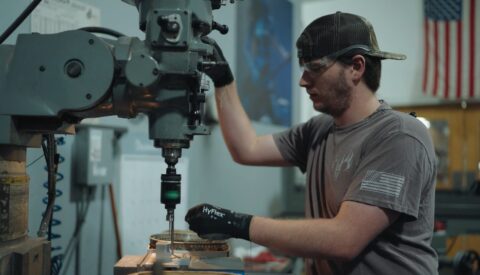
Where the art comes in is there’s certain things that you just cannot automate, right? So, things that require a human to feel what’s going on and really understand how the thing is working.
For parts that end up in mission-critical applications — think aircraft flight controls or medical devices — that human element is irreplaceable, Bradley argued. Automation has its place, he noted, particularly for processes that are well-understood and can be easily codified. But for the trickiest, most demanding jobs, there’s simply no substitute for a skilled pair of hands.
Greer echoed that sentiment from the perspective of Crossbow Systems, which specializes in solid rocket motors. Given the unforgiving nature of rocketry — “you only get one shot,” as he put it — diligence and risk aversion are paramount. And while the company prides itself on its ability to scale production quickly, it never loses sight of the need for absolute precision.
Brown, meanwhile, highlighted Fathom’s focus on tackling the most complex and challenging parts on behalf of its customers. With a network of highly certified facilities staffed by skilled labor, the company has built its reputation on its ability to deliver where others can’t.
So if automation alone isn’t the answer, what is the role of advanced technology in precision manufacturing? For all three panelists, it comes down to using machines as tools to enable and enhance human capabilities, rather than trying to replace them outright.
“What I will say is we do move at a pace faster than most,” Greer acknowledged. “What we also do is we’re very, very risk averse, because you only get one shot, right? With a rocket, you get one shot, and that’s it. You can’t take it back, you can’t refire it. So you have to be very diligent in everything you do.”
I loved how you described the problem as well, because those are novel problems that happen at a machine, right? And it happens everywhere. And I don’t care how much AI you throw at it — the human brain is what needs to solve that problem.
That balance — between leveraging the power of automation and preserving the artistry of human skill — is one that manufacturers everywhere are striving to strike. And as the Manufacturing Exchange event made clear, it’s a challenge that looks different in every corner of the country.
From the engineering talent and universities of upstate New York to the pristine shop floors of Charlotte to the master machinists of the Midwest, each region has its own unique strengths and culture. But what unites them all is a deep respect for the men and women who make precision manufacturing possible — and a recognition that no matter how smart the machines get, they’ll never be able to do it alone.
Or, as Bradley put it: “I don’t care how much AI you throw at it — the human brain is what needs to solve that problem.”
In other words? The machines may be getting smarter. But in manufacturing, the humans are still very much in charge — and that’s a good thing.
To hear more insights from Matthew Bradley, James Greer, and Chris Brown on the art and science of precision manufacturing, check out the full episode of the Manufacturing Happy Hour podcast. Special thanks to Fathom Digital Manufacturing for making this event possible, and to the Sisterhood of Trades for kicking off the evening’s festivities. You can find more information on all the guests and organizations mentioned at manufacturinghappyhour.com/287.