
When Matthew Bush founded HigherBotics back in 2015, he had a simple mission: to help manufacturers fill the gaps on their factory floors. Labor shortages were rampant, skilled welders were hard to come by, and traditional automation solutions were often too rigid or expensive for small to mid-sized shops.
Enter the cobot — the collaborative robot designed to work alongside humans, not replace them. Over the past eight years, Bush and his team have been at the forefront of the cobot revolution, developing cloud-connected systems that are as easy to use as they are powerful.
“We originally founded [HigherBotics] to solve a problem that we were having in manufacturing at the time, which was finding enough labor to fill our manufacturing plant,” Bush explained on a recent episode of the Advanced Manufacturing Now podcast. “So we set out to kind of solve that problem in a unique way. Cobots were new at the time, and so was the cloud. And so we solved it with a cloud-connected cobot.”
It’s been a really interesting kind of evolution of the landscape. As we started six years ago, everything kind of fit on the tabletop and relatively small parts. Today, we’ve got systems in the field that are welding 40-foot long items that have multiple robots in a single fixture welding on the part simultaneously.
That evolution has been nothing short of remarkable. What started as a niche solution for small, tabletop applications has grown into a full-fledged automation platform capable of tackling even the most complex welding tasks. HigherBotics’ systems can now handle parts up to 40 feet long, with multiple robots working together in a single fixture.
But for Bush, the real power of cobots lies not just in their technical capabilities, but in their ability to empower human workers. Rather than replacing skilled welders, he sees cobots as a tool to augment their expertise and make their jobs easier.
“It’s amazing the number of customers that we have that wind up hiring more people — welders, everybody — after they start adopting the robots,” Bush said. “A lot of it’s driven by, I can go back to running a plant 12, 13 years ago and sitting down with our employees as we were beginning the journey. We’re bringing robots in, right? And the message was always, we’re not bringing robots in to replace people. We’re bringing robots in to become more competitive globally and to fill the positions that we can’t fill.”
Of course, that doesn’t mean the transition to cobots is always smooth. One of the biggest challenges manufacturers face, Bush noted, is finding enough skilled robot operators and programmers to keep their automated systems running.
That’s why HigherBotics has focused so heavily on making its technology as user-friendly as possible. The goal, Bush said, is to create a tool that welders can pick up and use with minimal training — not something that requires an engineering degree to operate.
As we look at how we develop our technology, we’re always focused on, how do we make the technology such that there isn’t a large learning curve? It becomes a tool for the welder, not a robot programmer, not an engineer.
Looking ahead, Bush sees even more opportunity for cobots to transform the way welding is taught and practiced. He envisions a future where students learn to weld using robots from day one, gaining a deeper understanding of the process parameters and how to optimize them for different applications.
“We were talking about, you know, an approach in schools around, we don’t necessarily need to teach kids how to manually weld,” he said. “We need to teach them how to weld. But it could be the robot is actually how they weld. But they need to know how to weld to make the robot weld properly.”
It’s a bold vision — one that would have seemed far-fetched just a decade ago. But if the past few years have taught us anything, it’s that the pace of technological change is only accelerating. And for manufacturers looking to stay ahead of the curve, cobots are rapidly becoming not just a nice-to-have, but a necessity.
“Nobody wants to do that,” Bush said of the repetitive, monotonous tasks that once defined manufacturing work. “And so, you know, part of our challenge is, how do we reinvigorate manufacturing as a desired career path? So that people want to come into manufacturing. Kids coming out of high school see manufacturing as a place that can actually be fulfilling, can provide them with a good career, can provide them with a good standard of living.”
If HigherBotics has its way, the answer will be clear: just add cobots.
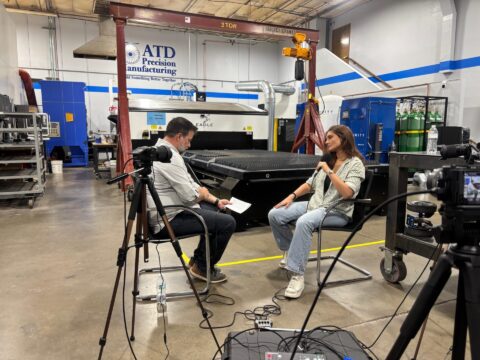
To learn more about HigherBotics and its cloud-connected cobot solutions, visit www.higherbotics.com or find them on LinkedIn. You can also hear Matthew Bush’s full conversation with host Carrie Gitter on the Advanced Manufacturing Now podcast.