
There was a time, not so long ago, when autonomy was more science fiction than shop floor. When robots were the stuff of trade show gimmicks and proof-of-concept pilots, not real-world deployments at scale.
But if you want to see how quickly that’s changing, look no further than Pittsburgh.
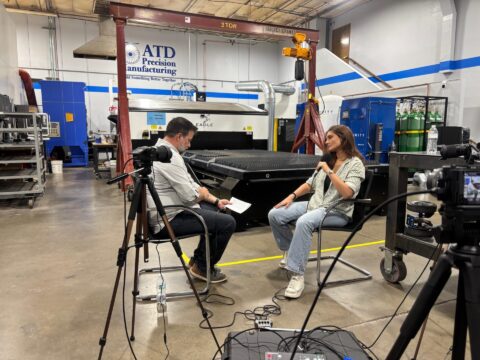
In a recent live taping of the Manufacturing Happy Hour podcast, host Chris Luecke sat down with three leaders at the forefront of the city’s autonomy revolution: David Griffin of Seegrid, Mike Smoser of MindVision Systems, and Brett Phillips of Hellbender. And as they made clear, the robots aren’t just coming — they’re already here, and they’re transforming industries from mining to manufacturing.
“When I graduated, there were sections of the city you didn’t go to that are now the hottest spots in the city,” Phillips recalled of his time as a student in Pittsburgh. “Steel industry had moved out, but it’s really technology that filled that gap, and the evidence is all around us.”
You have to have people that are willing to get their hands dirty. What’s going to separate us moving forward is the ability to sort of mash this really high-level, very technical engineering with real-world manufacturing. That is where uniquely Pittsburgh stands alone.
For the panelists, that blend of cutting-edge technology and roll-up-your-sleeves work ethic is what sets Pittsburgh apart as an autonomy hub. It’s a place where researchers and roboticists rub shoulders with machinists and makers — and where the goal is not just to invent the future, but to build it.
So what does that look like in practice? For Griffin, whose company Seegrid makes autonomous mobile robots (AMRs) for the warehouse industry, it means starting with a win.
“Pick an application that can be achieved, that is very low risk,” he advised manufacturers looking to dip their toes into the autonomy waters. “It is less of an impact to your organization, less of an operational change, less of a change management situation with your employees. Get a win under your belt, get a second win under your belt, and kind of keep progressing in complexity and significance from there.”
Phillips, whose company Hellbender develops perception systems for autonomous vehicles, agreed — but added that it’s critical to understand the ROI from the outset.
“Really understand the ROI calculation,” he urged. “Because I think a lot of people, when they misstep, they just chase the word without really understanding the impact.”
That impact, the panelists argued, has never been more attainable than it is today. Advances in technology, coupled with a maturing ecosystem of suppliers and integrators, have made autonomy more accessible than ever before.
“Ten years ago, it was true R&D,” Phillips said. “Maybe 20 years ago, it was sort of a pipe dream, right? But now, it is just simply, can you identify the right use case, and can you actually execute?”
The real answer is, get started immediately, right? It is definitely a journey, and that journey takes time. And so the quicker you start, the quicker you can evolve through that journey.
For Smoser, whose company MindVision Systems brings autonomy to the mining industry, the key is to balance action with strategy.
“If you don’t know what to do, do something,” he advised. “Make sure that you have a strategy — you can’t be a slave to either one. The first, if you do it wrong, you’re reckless. The second one, you analyze forever, and you don’t do anything.”
Striking that balance is where organizations like the Pittsburgh Robotics Network come in. With more than 130 members spanning startups, established companies, and academic institutions, the PRN is at the center of the city’s autonomy ecosystem — and a key reason why Pittsburgh is poised to lead the industry into the future.
“I think the challenge for Pittsburgh is going to be to be bold and tell people, right?” Phillips mused. “We have all the engineering talent in the world. We have all the manufacturing talent in the world. The problem is that we’re a little too Midwestern humble.”
If the success stories keep piling up, though, that humility may give way to something else: a well-earned swagger, backed up by the kind of gritty, get-it-done spirit that has always defined the Steel City.
“What we have going on here is very special,” Smoser reflected. “Give it up for Chris and the Rust Belt Renaissance tour wrapping up in Pittsburgh. And give it up for Mike and David and Brett. And actually, give it up for yourselves, the members — because without you, this wouldn’t be possible.”
In other words? The robots are ready for their close-up. And Pittsburgh is more than happy to play host.
To learn more about the Pittsburgh Robotics Network and its mission to grow the robotics and autonomy ecosystem in the Pittsburgh region, visit robopgh.org. And to catch more insights from industry leaders like David Griffin, Mike Smoser, and Brett Phillips, subscribe to the Manufacturing Happy Hour podcast on your favorite podcast platform or at manufacturinghappyhour.com.