
When Danny Gonzales looks at the world of manufacturing marketing, he sees a lot of missed opportunities. Too many companies, he argues, are still stuck in the old ways of doing things — churning out dry, technical content that fails to connect with its audience on a human level.
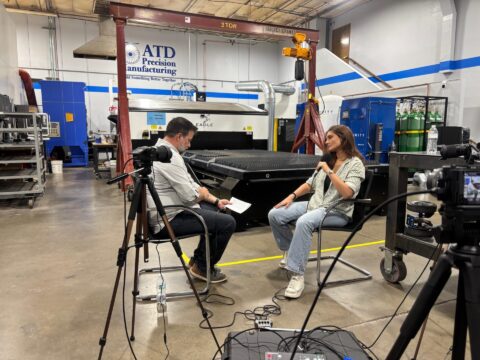
“We realized that the manufacturing industrial space was really, we felt, very underserved,” Gonzales explained on a recent episode of the Manufacturing Happy Hour podcast. “We had done a lot in that space, and it was always felt kind of magical to go into a manufacturing plant and see what was going on.”
That realization led Gonzales to launch Industrial Sage, a media company dedicated to helping manufacturers tell their stories in a way that resonates. Drawing on his background in video marketing — his agency, Optimum Productions, has been creating B2B content since 2007 — Gonzales set out to show industrial brands how to think and act like media companies in their own right.
Central to that mission, he argues, is a shift away from the highly polished, product-centric videos of old and toward a more authentic, relatable style of content creation.
“The idea of these highly produced, you know, three-minute videos, it can still work, but it’s not going to be the end-all-be-all,” Gonzales said. “I think what we’re seeing is, especially in the last few years, is this desire to have a little bit more of that authentic, maybe not as polished content. Maybe it’s a little bit more selfie-style.”
Storytelling is how people communicate the best way. If you’re familiar with Donald Miller and StoryBrand, the whole idea that it kind of puts you in this frame of, ‘I’m the assistant, I’m not the hero.’ I like how that shifts some of that mentality a little bit.
But authenticity alone isn’t enough, Gonzales cautions. To truly capitalize on the power of content, manufacturers need to approach it with a clear strategy and a consistent cadence — not just the occasional one-off “viral” video.
“What ends up happening is they get excited about this whole idea of doing video, and then they go and do a project,” he said. “But they don’t really think about it in terms of, what does a real strategy look like? What are the goals? What are we really trying to accomplish?”
The key, Gonzales believes, is to find the right mix of produced and impromptu content to build what he calls the “know, like, trust” factor with your audience. And perhaps most importantly, it’s about using that content to communicate not just what you do, but why it matters.
That’s where storytelling comes in. By tapping into the emotional and narrative elements of their work, Gonzales argues, manufacturers can help their audiences understand the bigger-picture impact of what they do — and inspire a new generation of talent to join the industry in the process.
He points to the example of a tire shredding equipment manufacturer his team worked with. Initially, the company saw itself as just another maker of industrial machinery. But as Gonzales and his crew dug deeper, they uncovered a story of global impact.
“Did you guys realize that the tires and the idea of tire recycling is a huge, huge opportunity, but it’s also a huge problem in the world?” Gonzales recounted asking the company’s leaders. “We start unpacking this, and we say, actually, you guys are helping to solve this. I know you’re not tackling the whole thing, but here’s kind of how you guys are helping to solve that problem.”
It totally changes that purpose and that mission and that value, to the point where we’ve had that where we’ll bring in our production crews and we’ll have people that know nothing about manufacturing. They’ll kind of go in there first and they’re like, ‘This is kind of like, I don’t know what’s going on here.’ And then at the end of the day, after they hear the stories and the impact and what’s happening, they’re like, ‘This is super cool, this is amazing, I had no idea.’
That shift in perspective, Gonzales says, is the real power of storytelling in manufacturing. By helping companies articulate the meaning and purpose behind their work, it can transform everything from employee retention and recruitment to sales and marketing.
And for a new generation of digitally native workers, that sense of purpose is more important than ever. Gonzales recalls one young member of his own team who, after being exposed to the hidden world of manufacturing through Industrial Sage’s work, decided to pivot his career path entirely.
“He was like, ‘I gotta make a confession, I’m going back into school, I’ve been going to school early in the mornings, I’m getting up on my programming, and I basically want to go into the manufacturing field because I see all these problems that I feel like I can solve, and it’s really cool, and I had no idea about this before,'” Gonzales said. “Huge win.”
For manufacturers struggling to attract and retain talent in a tight labor market, that kind of lightbulb moment can be game-changing. And as Gonzales sees it, it all starts with the stories we tell — and the way we tell them.
“From a selling standpoint, when you are able to really kind of show that bigger picture impact, you could be selling, ‘Hey, come work for me,’ or you could be selling, ‘Hey, continue to work for me,’ or you could be selling, ‘Hey, buy from me,'” he said. “These are all really important ways of being able to communicate that value proposition in ways that are very meaningful and very impactful.”
In other words? It’s time for manufacturing to embrace its inner storyteller — and write a new narrative for the industry in the process.
To learn more about Danny Gonzales and his work with Industrial Sage, visit industrialsage.com or connect with him on LinkedIn. For more insights on storytelling and content creation in manufacturing, check out Gonzales’ interview on the Manufacturing Happy Hour podcast, available on all major podcast platforms.