
When Kent Macken looks at the state of manufacturing automation today, he sees a landscape ripe for disruption. Traditional robotics, he argues, has focused on the low-hanging fruit: high-volume, single-task production lines that make up a mere 10% of the industry. The real opportunity lies in the other 90% — the high-mix, high-variability environments where automation has historically struggled to gain a foothold.
That’s the challenge that Macken and his team at Worker Labs are tackling head-on. Their mission? To deploy the world’s largest robotic workforce, one factory floor at a time.
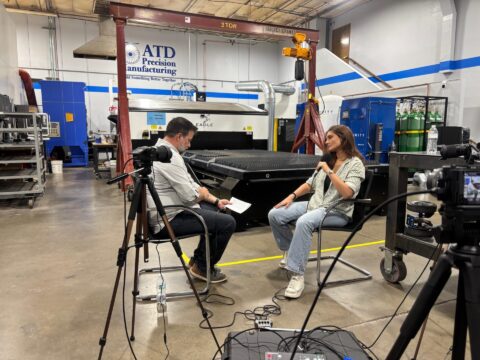
“We’re not like a robotics company, as people kind of are really crazy about these days. That’s all the hype and stuff,” Macken explained on a recent episode of the Manufacturing Executive podcast. “We’re actually seeing ourselves more as a workforce company. We help manufacturers solve their biggest, most painful challenges out there.”
We’re robots that come in and do the same job as a human would do for the repetitive, the dull, dirty, and dangerous — the three D’s, those tasks that lead to high turnover. We’re a workforce company. We fit the team.
At the heart of Worker Labs’ approach is a deceptively simple idea: make robotics so easy that anyone can use them. The company’s robots are controlled via a no-code interface that’s accessible from an ordinary tablet, with training that takes a mere 10 minutes. The goal is to empower operators to become robot wranglers, not replace them with machines.
It’s a philosophy that’s resonating with manufacturers who have long been wary of automation. Macken notes that many of his conversations with potential customers start with some variation of “we don’t do robots” — a perception often rooted in past failures, high upfront costs, and long implementation timelines.
But as he walks them through Worker Labs’ collaborative robotics (or “cobot”) platform, Macken sees those objections start to melt away. Operators realize that the robots are there to take on the tasks no one wants to do anyway, freeing them up to focus on higher-value work. Leaders see opportunities to boost capacity, take on new projects, and grow their top line.
There is technology out there now that can improve my business, make it more efficient, increase output, drive higher utilization with my existing team. That’s what we need to start thinking about.
The shift in mindset couldn’t come at a more critical time for U.S. manufacturing. Macken points to China, which has been installing roughly half of the world’s new industrial robots annually for several years running. By comparison, the U.S. has been “shrinking or very flat” in its adoption curve.
“Automation works, and it’s not just for high volume anymore,” Macken said. “It can do more tasks than ever. We’re not saying that it can do every task — I’m the first to say that’s a long way away. But it’s not that 10% of tasks. It’s that 15, 20, 25% of tasks that we’re sort of moving towards.”
For manufacturers looking to dip their toes into the automation waters, Macken has some straightforward advice: start by looking at your current pain points. Where are you struggling to hire or retain staff? What tasks are causing high turnover or safety issues? Those are the prime candidates for a robotic assist.
Just as importantly, he urges leaders to involve their frontline teams from the start. Make it clear that the robots are there to help, not to replace human workers. Encourage operators to get hands-on with the technology, to see it as a tool that can make their jobs easier and more rewarding.
Because at the end of the day, Macken argues, the companies that will thrive in the coming years won’t be the ones with the flashiest tech or the most buzzword-laden press releases. They’ll be the ones that have figured out how to harness automation as a force multiplier for their human talent — and that have built a culture where humans and robots can work side by side.
“It’s not a piece of technology. It’s part of the team, it’s part of the workforce,” he said. “And that’s where it’s really key. Get them involved. Have them see it. Have them be able to be close to it. Have them be able to use the technology as a tool to help them do more. That is the key thing that unlocks it for a lot of businesses.”
In other words? The future of manufacturing won’t be humans versus machines. It will be humans and machines, working together in ways we’re only just starting to imagine. And if Macken and his team have their way, that future might be closer than we think.
To learn more about how Worker Labs is reimagining industrial automation, visit worker-labs.com. You can also connect with Kent Macken on LinkedIn or catch Worker Labs at upcoming industry events like NVIDIA’s GTC conference.