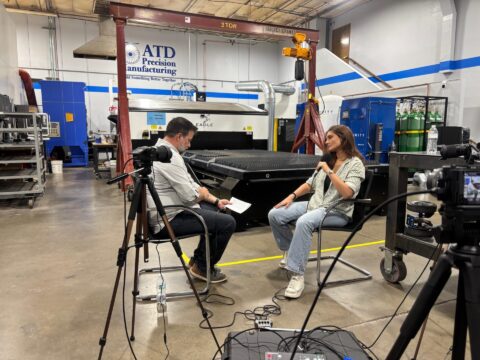

In a recent episode of the Manufacturing Happy Hour podcast, host Chris Luecke sat down with Felipe Sabino Costa, Product Marketing Manager for Networking and Cybersecurity at Moxa, to explore how AI is redefining OT data transmission and network security requirements.
Costa, who also serves as Cybersecurity Director and an official ISA/IEC 62443 instructor, emphasized that the role of OT data has fundamentally shifted in the age of AI. “Nowadays, OT data is even more; it’s not anymore about logging and making just, let’s say, historical data analysis,” he explained. “It’s more like about predictive power, instant control, precision.”
This transition from reactive to predictive decision-making is enabling faster, mid-process adjustments — but it’s also placing immense strain on legacy OT systems. Many of these networks, designed 15 or 20 years ago, simply lack the bandwidth to support data-hungry AI applications.
So definitely the system was not designed for that. So this is the first challenge, how I enable AI with this very old infrastructure.
Compounding the challenge is the shift from isolated, standalone OT networks to interconnected systems that exchange data with the cloud and corporate data centers. The sheer volume and complexity of data now traversing these networks is, in Costa’s words, “basically a huge headache for all the people, including myself, that need to make it happen.”
But it’s not just bandwidth and architecture that need to evolve. As AI becomes more deeply embedded in manufacturing, it’s also introducing new security risks. Costa pointed to the example of AI-powered malware that can adapt and spread at lightning speed. To keep pace, OT security solutions must themselves leverage AI and machine learning.
Fortunately, standards and certifications are emerging to help manufacturers navigate this new landscape. Costa highlighted the ISA/IEC 62443 series, which provides guidelines for secure product development and incident response, as well as the ISO 27000 family of standards for protecting customer data.
So definitely it’s also about the process. It is not something that I define following this standard and have some other company come by and make sure I’m doing it’s good for everybody. So this is why we are seeing this standardization in how we define security is going to be the future.
On the solution front, Costa emphasized the importance of network segmentation at the edge and visibility tools to detect and respond to incidents. But he also stressed that technology alone isn’t enough — manufacturers need to partner with vendors who deeply understand both networking and security.
Looking ahead, Costa sees no slowdown in the adoption of AI in manufacturing, nor in the corresponding evolution of cyberthreats. His advice to manufacturers? Find a knowledgeable partner to help plan and implement OT network changes securely.
“If you are unsure how to do it, keep in mind, any change, if you change anything in the system, can create incidents, right? If you don’t know exactly what you’re doing,” he cautioned. “So find a partner, a company, right? Moxa, obviously, is one of the companies that I work for that I know I can recommend, that we take the topic seriously.”
As AI propels manufacturing into a new era of efficiency and innovation, OT security can no longer be an afterthought. The threats are real and evolving — but so too are the tools and expertise to help the industry stay secure. The convergence of AI and OT is upon us, and with the right approach, it promises to be a productive one.