
When Matt Bedingfield looks at America’s reshoring push, he sees a glaring gap that almost nobody’s talking about. We’re building the factories, sure. But what about the stuff that makes them run?
“The reshoring is phenomenal that we’re doing,” Bedingfield said on a recent episode of the Manufacturing Executive podcast. “But I think there’s a huge missing piece in the supply chain — in the raw material side that’s being ignored.”
We hear all the exciting news coming out of Washington, you know, there’s not a week that goes by with the DOE or DOE or one of the other departments doesn’t put up tens of millions if not a couple billion dollars towards solving this problem. But I’m not sure that a lot of companies know exactly how to plug into that.
Bedingfield is the CEO of Mint Innovation, a company that’s on a mission to turn one of the country’s biggest waste streams into a critical resource. Mint recovers precious metals like gold, copper, palladium, and silver from electronic waste, or e-waste — the discarded phones, computers, and other gadgets that Americans toss out by the millions every year.
It’s a problem that’s only getting bigger. The U.S. generates between 8 and 10 million tons of e-waste annually, and that number is growing at a rate of 8 to 14% per year. But despite the value locked inside all those old devices, the recycling rate is a paltry 15 to 20%.
For Bedingfield, that’s not just a missed opportunity — it’s a national security risk. Many of the metals found in e-waste are classified as critical minerals, meaning they’re essential to everything from renewable energy to defense technology. And right now, the U.S. is heavily dependent on foreign sources for those materials.
“The U.S. has a shortage of critical minerals, which we’ll get into,” Bedingfield said. “And we need to take the bull by the horns with this.”
That’s where Mint comes in. By pairing secure data destruction with domestic minerals recovery, the company is hoping to turn the e-waste stream into a reliable source of raw materials for American manufacturers.
It’s an ambitious goal, but one that Bedingfield believes is achievable — with the right combination of public and private sector support. He points to the funding that’s already flowing from Washington, with agencies like the Department of Energy and the Department of Defense putting up billions of dollars to solve the critical minerals problem.
The challenge, he says, is making sure that money gets into the hands of the companies that can actually put it to use.
So how do you access those funds? How do you move quickly?” Bedingfield asked. “And how do we get started on solving it? I think matching that capital being available with the capital that’s ready to be deployed so that we can have a cohesive plan to move together as a country to solve the problems quickly as we can.
Part of the solution, Bedingfield argues, is building an ecosystem around e-waste processing rather than trying to tackle the problem one company at a time. He’s seen firsthand the power of collaboration through his work with MI2, the Meadows Innovation Initiative — a metals cluster he helped found in Kentucky.
By bringing together companies like Novellis, Nucor, and North American Stainless, MI2 was able to create talent pipelines and safety programs that no single firm could have managed on its own. The group also secured support from the governor and local universities, who saw the value in supporting an industry that collectively represented some 38,000 jobs in the state.
Bedingfield believes a similar approach could work for e-waste. By coordinating efforts across the public and private sectors, he thinks it’s possible to create a system that not only keeps valuable materials out of landfills, but also ensures a steady supply of critical minerals for American manufacturers.
“When you’re looking at mines, you’re looking at decades to get those installed, and you can’t put resources in the ground,” he said. “When you’re looking at a smelter, you’re probably looking between five and ten years to build, depending on how large-scale you go. Mint’s technology is 15 months.”
In other words? It’s going to take a mix of solutions — from urban mining to traditional extraction — to solve the critical minerals crunch. But if Bedingfield has his way, e-waste will be a big part of the equation.
“That combination of starting to layer these things in, make sure that we’re not relying on one thing, but we’re staggering it as we build the infrastructure out,” he said. “So that’s another example of I think it’s an ‘and’ solution, not one or the other.”
For Mint, the next step is scaling up its technology in the U.S. The company recently leased a site in Longview, Texas, where it plans to build out its first American processing facility. Bedingfield, who’s based in Louisville but leads a team that spans from New Zealand to Australia, is now focused on raising the capital to make that vision a reality.
“We’ve got a first site selected in Longview, Texas. We already have it under lease. We’re working on site work and things of that nature right now while we’re raising capital to fund the build,” he said. “So for over the next few months, that’s exactly what I’ll be focused on.”
It’s a tall order, but one that Bedingfield believes is essential if the U.S. is going to take control of its critical minerals future. Because while reshoring may be bringing manufacturing back to American shores, it’s the raw materials that will ultimately determine whether this renaissance has legs.
“We’re very much excited to plug in here and grow and hopefully be a big part of the solution,” Bedingfield said.
For the sake of America’s manufacturing future, let’s hope he’s right.
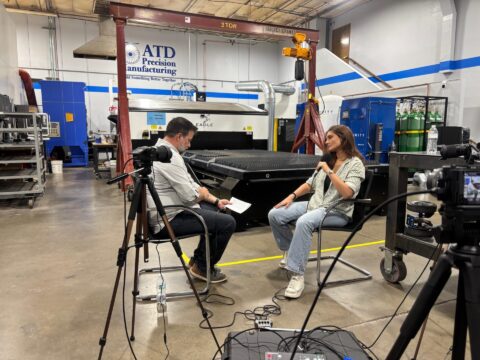
To learn more about Mint Innovation and its mission to turn e-waste into a national resource, visit the company’s website at mint.bi or follow along on LinkedIn. You can also hear Matt Bedingfield’s full conversation with Manufacturing Executive host Joe Sullivan wherever you get your podcasts.