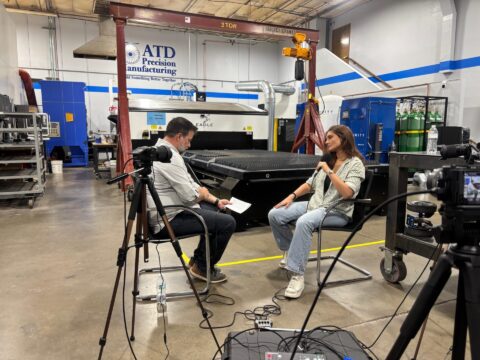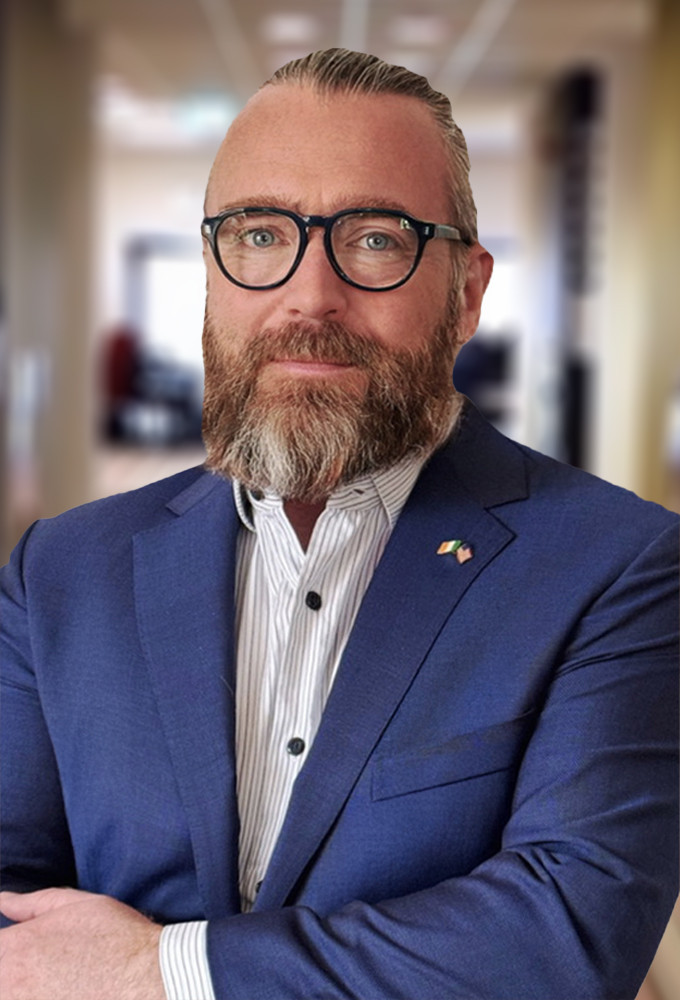

On a recent episode of The Manufacturing Executive Podcast, host Joe Sullivan sat down with de Stonndún, CEO of Automated Industrial Robotics (AIR), to talk about how he’s built a global automation business by doing nearly everything differently than the traditional playbook suggests. No roll-ups. No facility-first project assignments. No acquisitions driven by spreadsheets alone.
De Stonndún’s path into automation started at 15, as an apprentice at Guinness in Dublin. He fell in love with making processes more efficient and left Ireland in 1997 to work for Hewlett-Packard in the U.S., where he saw firsthand what high-value automated manufacturing looked like at scale. Twenty-five years later, he leads a company that builds specialized assembly and test solutions for customers across life sciences, automotive, food and beverage, and cosmetics.
AIR exists today in large part because de Stonndún found the right capital partner. He’s been on both sides of the private equity experience — one that ultimately pushed him out, and another that gave him the alignment he needed to build something lasting. The lesson he draws from that isn’t about the type of capital. It’s about whether the people providing it share your vision for what you’re actually trying to create.
Where AIR really diverges from the industry norm is in how it evaluates acquisitions. Most companies start with technology, market share, or financials. De Stonndún starts with people and culture — and has walked away from impressive businesses when the fit wasn’t right.
His reasoning is disarmingly simple. The technology in automation has gotten so good that it’s no longer what separates one company from another. Robots are reliable. Vision systems are sophisticated. The components are excellent. What makes the difference is the ingenuity, motivation, and standards of the people behind it.
Robots don’t just break. Robots are robust. Vision systems are fantastic. They’re getting more intelligent. So it really comes down to the right ingenuity, the right people, the right teams, the right dynamic that you can put behind that.
When AIR acquires a company, the integration process spans 17 to 18 work streams across every department. But it isn’t top-down. Teams from the acquired company are brought into a collaborative process to figure out — together — the best way to do things. And the expectation is that “best” is temporary. New companies joining AIR might bring a better method, and the whole organization iterates.
The structural result of all this is what de Stonndún calls a “wallless” company. AIR operates with one quality system, one engineering approach, and one culture. Customers get an identical experience regardless of which facility — or how many facilities — touch their project.
That last point is the real differentiator. When a new project comes in, AIR doesn’t start by asking which plant should handle it. They start by asking who the best subject matter experts are across the entire organization — whether those people sit in England, Ireland, or the United States. Phase one is designing the best possible technical solution. Phase two is figuring out how to operationalize it. Geography is an afterthought.
It’s an approach that only works because of the integration work AIR has done on the back end. And it’s one that de Stonndún says customers genuinely appreciate, because the focus stays on solving their problem rather than fitting their problem into a facility’s capabilities.
On the question of whether automation replaces workers, de Stonndún doesn’t hedge. The demand he sees isn’t driven by companies looking to cut headcount. It’s driven by tolerances so tight that human hands physically cannot do the assembly — pacemakers, orthopedic implants — and by production volumes that simply outstrip available labor. “Lights out” manufacturing, in his experience, is more Instagram than reality. People remain integral to every system AIR builds.
He sees AI in the same light: a tool to make people and systems more effective, not to replace either. He points to overall equipment efficiency rates in U.S. manufacturing, which top out around 70 per cent even at world-class facilities. That means 30 per cent of the time, equipment isn’t running optimally. AI’s biggest opportunity, in his view, is chipping away at that gap — faster root-cause analysis, predictive maintenance, digital twins — while freeing up technicians and engineers to solve harder problems.
But he’s careful to draw a line between using AI as an enhancer and using it as a shortcut. AIR is focused on the former.
When Sullivan asks what success looks like, de Stonndún doesn’t talk about revenue or margins. He talks about permanence.
When I’m gone, and the company is still delivering the same cool products, the same innovation… if that sustains me and the leadership team today, in years from now, that’s ultimate success.
It’s the kind of answer that could sound like a platitude from someone who hasn’t done the work. From a CEO who evaluates every acquisition on culture first, integrates companies across 18 work streams, and assembles cross-continental teams for every project, it sounds like a business strategy.
And from the sound of it, it’s working. De Stonndún says his only complaint is that there are only seven days in the week.