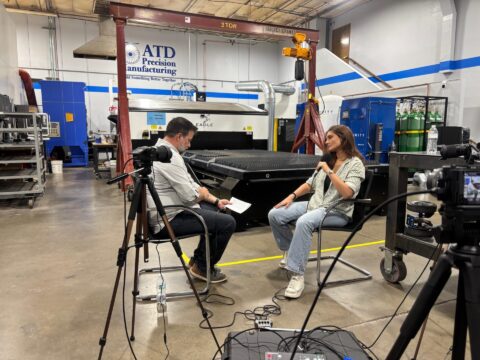

For Matt Hannula, CEO of Tinker Tim Company, the decision to move manufacturing from China to Mexico was about more than just geography. It was a bold bet on speed, control, and resilience in an increasingly turbulent global landscape.
“Crossing oceans is hard, right? Crossing roads is not as hard,” Hannula explained on a recent episode of the Manufacturing Executive podcast. “I think a lot of us would take a cross-country trip in a car, no problem, take our families. I don’t think a lot of us would say, yeah, let’s get on a boat and try to cross the country, right?”
Hannula and his team at Tinker Tim, a retail fixture manufacturer, began exploring nearshoring to Mexico well before the COVID-19 pandemic upended global supply chains. They saw mounting risks in their Asia-centric production model: quality concerns, communication barriers, time zone mismatches, and geopolitical tensions.
Mexico, in contrast, offered a host of advantages. Lead times dropped from months to weeks. Face-to-face relationship building became possible. Logistics simplified dramatically, from a byzantine dance of boats, ports, and handoffs to a straightforward factory-truck-border sequence.
For us, from Mexico, we have factory, needs to produce, needs to load a truck, that truck needs to be able to make it to the border, cross the border and then the next truck needs to make sure it gets to a client site. It is so simplified compared to the model of producing in China.”
Perhaps most strikingly, Tinker Tim all but eliminated the 2% defect rate they had accepted as a cost of doing business in China. With greater visibility and control over production, quality soared.
But the transition wasn’t without challenges. Hannula emphasized the importance of having a trusted stateside partner to manage relationships in Mexico. Navigating cultural and legal differences required painstaking diligence, extensive questioning, and a willingness to start small and learn from mistakes.
Hannula also stressed the need for supply chain diversification more broadly. Relying on a single point of failure — whether a factory, a shipping partner, or an entire country — is a recipe for disruption, especially in the high-stakes world of retail where delays can derail entire store openings.
If you don’t find those issues or challenges or pockets early on and you’re doing big scale, that’s something that can tank your company, right? That’s something that if there’s product defects or there’s quality issues that weren’t foreseen, that you didn’t see in small batches, try to understand how that stuff works.
For manufacturers eyeing a nearshoring move, Hannula’s advice is to go deep on the details. Ask every question imaginable. Shoulder the short-term costs of small-batch production to surface problems before they scale. And above all, ensure you have a trusted guide to navigate the complexities of cross-border operations.
The payoff, as Tinker Tim has discovered, can be transformative. In an era of mounting supply chain volatility, the ability to build resilience through regional partnerships is fast becoming a competitive necessity. For manufacturers ready to make the leap, the road to Mexico may be shorter than they think.
To learn more about Tinker Tim Company’s nearshoring journey, connect with Matt Hannula on LinkedIn or visit tinkertim.com. You can also follow the company on Instagram @tinkertimcompany.