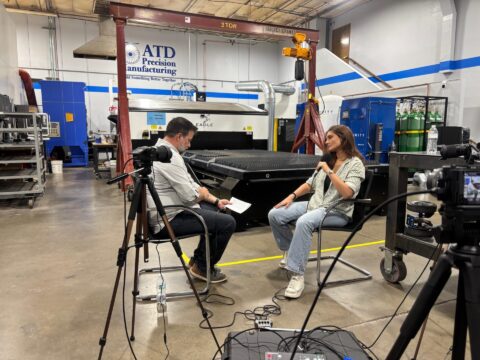

In a recent episode of the Advanced Manufacturing Now podcast, SME Media editors Rachel Thomas and Michael McConnell took a deep dive into the article, which explores how veterans can help plug the growing skills gap in the manufacturing sector — and why so many employers are missing out on this untapped resource.
As McConnell notes, the numbers speak for themselves. “Every year, about 200,000 US service members leave the military,” he explained. “And you think about all those veterans coming out every year — that really could fill a lot of that need. It’s just a question of making those matches.”
You think about all those veterans coming out every year — that really could fill a lot of that need. It’s just a question of making those matches, which takes some effort.
The challenge, McConnell found, is twofold. On the veteran side, many transitioning service members simply don’t know how to translate their military experience into language that civilian recruiters can understand. The military, like any specialized field, has its own jargon and terminology that can read like a foreign language to the uninitiated.
“If you put that on a resume and send it into a listing on Indeed.com or ZipRecruiter or something, a lot of those recruiters and HR people won’t know what they’re talking about,” McConnell said. “And so that is a legitimate fear.”
On the employer side, meanwhile, many manufacturers simply aren’t aware of the depth of talent and experience that veterans can bring to the table. But those who do understand the value proposition are reaping the benefits.
McConnell pointed to the example of Michael Figaro, a 20-year Army veteran who struggled with the transition to civilian life before landing a job with a military contractor that appreciated his first-hand knowledge of the equipment they produce.
“Michael Figaro is the gentleman I’m talking about,” McConnell recounted. “They liked the fact that he knew about defense equipment. He knew about this — this was a military contractor, and they really liked that he knew a lot of their stuff when he walked in the door.”
If you are a manufacturer or your company and you don’t have a program in place to educate about veterans or to be veteran friendly, work with them. [Veteran support organizations are] happy — a lot of these associations, Homes for Our Heroes, various organizations like that — they have programs in place to educate employers and say, ‘Hey, look, these veterans do exactly what you’re looking for.’
The good news, McConnell emphasized, is that a growing ecosystem of organizations exists to help bridge the gap between veterans and employers. From Workshops for Warriors to Hire Heroes USA to the Society for Human Resources Management, these groups are working to help veterans articulate their skills in civilian terms — and to help employers understand the value that veterans can bring to their organizations.
For manufacturers looking to tap into this talent pool, McConnell’s advice is simple: Seek out these organizations and learn from their expertise.
“If you are a manufacturer or your company and you don’t have a program in place to educate about veterans or to be veteran friendly, work with them,” he urged. “They have programs in place to educate employers and say, ‘Hey, look, these veterans do exactly what you’re looking for.'”
The payoff, for those who get it right, can be transformative. McConnell shared the story of one veteran who applied for a manufacturing role only to be hired on the spot as a recruiter, so taken was the company with his personality and potential.
“You just never know where your skills are going to transfer,” McConnell reflected.
As America’s manufacturing skills gap continues to widen — McConnell cited projections of 3 million unfilled jobs by 2033 — the sector can scarcely afford to overlook any source of talent. For companies ready to put in the work to connect with and support veteran hires, the upside could be huge.
“This is a problem that really puts it in numbers,” McConnell said of the looming skills shortage. “Clearly, there’s an opportunity here.”
For more insights on how manufacturers can tap into the veteran talent pool, check out Michael McConnell’s full article in the February issue of Manufacturing Engineering and Technology Magazine or visit AdvancedManufacturing.org.