
July 2026 Manufacturing Insights
U.S. manufacturing posted its strongest month in more than four years in July 2026. The two most closely watched survey readings, however, tell different stories about where the sector goes from here.
The ISM Manufacturing PMI jumped to 55.6 percent, the highest reading since May 2022, with employment crossing into expansion for the first time in 33 months. The S&P Global US Manufacturing PMI held flat at 53.9, solid by historical standards but built on the softest output growth in four months and the weakest business confidence since October 2025.
Both surveys agree on the pressure points. Supplier delivery performance is deteriorating at close to the sharpest rate in four years, input costs remain elevated despite three months of relief, and the Middle East conflict continues to reroute shipments and lift energy prices. What they disagree on is momentum. Capital, meanwhile, keeps landing, with more than a dozen new plant and expansion announcements across nine states.
A Month in Manufacturing Data
Perspectives from the ISM Report
The ISM Manufacturing PMI registered 55.6 percent in July, up 2.3 points from June and the sector’s seventh consecutive month of expansion following a 10-month contraction. All five subindexes feeding the headline number sat in expansion territory.
Production drove the gain, climbing 6.3 points to 58.5 percent, its highest level since November 2021. New orders edged up to 56.7 percent. Backlog of orders jumped 4.5 points to 55 percent, an early signal that demand is beginning to outrun available capacity. New export orders returned to expansion at 53 percent, the strongest reading since March 2022.
The employment index is the headline inside the headline. At 52.8 percent, up 3.1 points, it entered growth territory for the first time in 33 months, with 60 percent of panelists reporting their companies are hiring.
Fifteen of 18 industries reported growth, with Chemical Products the lone contraction. Prices eased for a third straight month to 71.1 percent, though raw materials costs have now risen for 22 consecutive months.
Insights from S&P Global
S&P Global’s US Manufacturing PMI came in at 53.9, unchanged from June and capping a full year of improving operating conditions. The stable headline masks a softer picture underneath.
Production volumes rose at the weakest pace since March, and new order growth eased for a third consecutive month as subdued client confidence and inflationary pressure weighed on demand. Export sales declined again, leaving what growth there was almost entirely domestic.
Supply chains were the standout problem. Vendor performance deteriorated at the second-sharpest rate in four years, trailing only May 2026, as the Middle East conflict drove delivery delays and material shortages. Finished goods stocks fell at the steepest rate since September 2023 as manufacturers filled orders from what they already had on the shelf.
Business confidence slipped to its lowest level since October 2025. Chris Williamson, chief business economist at S&P Global Market Intelligence, tied the slower trajectory to weakened new business growth compounded by supply chain delays, falling exports, and customer resistance to high prices.
What the Data Means
Some of the gap is mechanical. S&P Global collected responses between July 9 and July 28, while ISM accepts submissions through month-end. The two also weight sectors differently and draw on different panels.
The rest is real, and it comes down to where demand is concentrated. ISM panelist commentary describes data center products at full procurement and manufacturing ramp, semiconductor and connectivity demand booming, and defense demand at an all-time high. The same commentary notes that medical, industrial, and consumer order volumes are markedly lower. That is a two-speed sector. Suppliers positioned in semiconductors, power electronics, connectivity, and defense hardware are running hot. Everyone else is working through the demand environment S&P Global describes.
Sentiment reflects the split. Only 38 percent of ISM comments were positive, with pricing volatility cited in 57 percent of negative comments and the Iran war in 43 percent. Tariffs trailed at 18 percent.
For sourcing teams, the operational read is straightforward. Capital expenditure lead times stretched to 172 days and production materials to 87 days. Electronic components have been in short supply for 17 consecutive months and electrical components for 13. One electrical equipment panelist reported price increases of 5 to 25 percent on printed circuit board assembly components and 15 to 45 percent on bare boards, describing conditions as worse than the pandemic era.
Capacity is expanding. Availability is not, at least not yet.
New Factory and Manufacturing Announcements
July’s announcements spanned automotive, aerospace, semiconductors, grid infrastructure, and rail. Five stand out for scale and strategic significance.
Toyota’s $3.6 Billion San Antonio Expansion
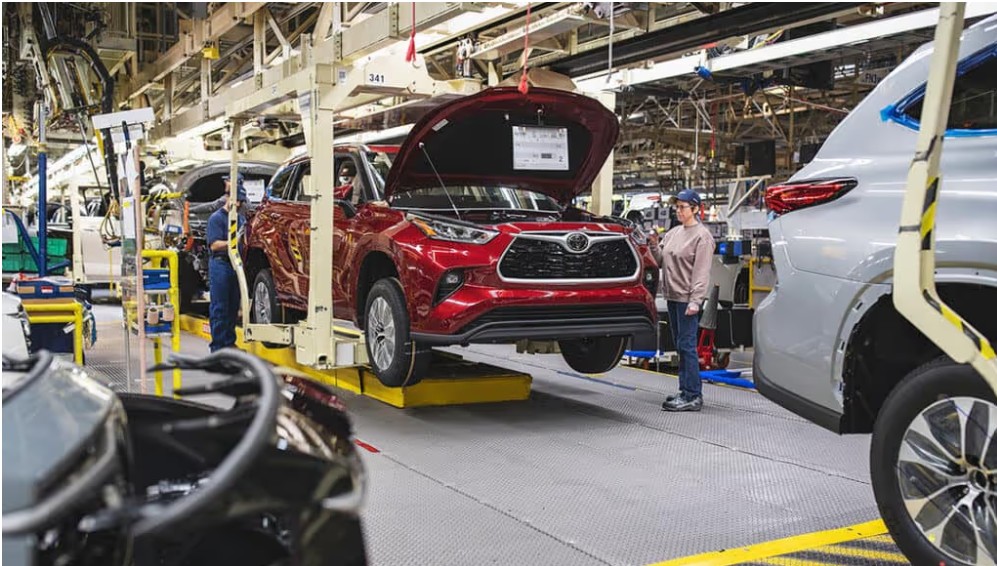
Toyota Motor North America will invest $3.6 billion to add a second assembly line at its San Antonio campus, dedicated to the Tacoma pickup. Announced July 6, the expansion adds 2.5 million square feet, doubles the site by 2030, shifts Tacoma production from Baja California to the United States, and creates 2,000 jobs.
Bosch’s $2 Billion Silicon Carbide Buildout in Roseville, California
Bosch announced on July 13 a Department of Commerce agreement for up to $225 million in CHIPS Act funding, supporting an investment of up to $2 billion to convert its Roseville site to silicon carbide production. The facility has begun sample production and expects first commercial chips on 200-millimeter wafers this year. It creates 700 jobs and could account for more than 40 percent of U.S. silicon carbide device capacity, the foundation for EV powertrains, industrial drives, and data center power conversion.
Electra’s $850 Million Aircraft Plant in Springfield, Ohio
Announced July 21 at the Farnborough International Airshow, Electra selected Springfield for its first production facility, an $850 million investment creating 1,975 jobs. The plant will build the EL9 Ultra Short, a nine-passenger hybrid-electric aircraft that operates from 150 feet of runway, at 400 aircraft per year, scaling to 800. Electra evaluated more than 140 sites before choosing Clark County.
Hitachi Energy’s $457 Million Transformer Facility in South Boston, Virginia
Hitachi Energy broke ground on June 29 on a $457 million expansion that will become the nation’s largest producer of large power transformers, adding roughly 825 jobs in Halifax County. It is part of more than $1 billion the company is putting into U.S. grid equipment manufacturing. Large power transformers are among the most constrained items in the electrification supply chain, with lead times measured in years.
Flex and Cerebras Scale AI Supercomputer Production in Milpitas
Flex and Cerebras Systems announced on July 9 an expanded partnership to scale production of the Cerebras CS-3 at Flex facilities in Milpitas, California. New assembly and integration lines come online through 2026 to support an anticipated sevenfold capacity increase. Each system requires precision mechanical assembly, high-power electrical integration, liquid cooling, and full-rack qualification, work that pulls a deep domestic supplier base with it.
Elsewhere, Kratos opened a 167,000-square-foot defense facility in York, Pennsylvania, and expanded Sacramento to build Elroy Air’s Chaparral cargo aircraft. Velo3D opened Forge 1 in Livermore, California, and Beehive Industries committed $70 million to 3D-printed jet engine production in Ohio. Stadler, Foxlink, Goldhofer, Pierre Guerin, and Detpak also announced U.S. plants or expansions.
Future Outlook
July delivers the sector’s best headline number in four years and its clearest warning signs in nine months at the same time.
The constructive case is straightforward. Backlogs are building, export orders returned to growth, and manufacturing employment expanded for the first time since late 2023. Customers’ inventories remain in “too low” territory for the 22nd consecutive month, which historically supports future production.
The caution is equally clear. Growth is narrow, riding AI infrastructure and defense while consumer and general industrial demand softens. Supply chains are tightening rather than loosening. Input costs have eased three months running but sit well above normal, and the Middle East conflict remains an unresolved variable sitting on top of freight, fuel, and lead times.
The practical priorities have not changed. Qualify second sources on electronic and electrical components now rather than when a line goes down, and treat quoted lead times on power electronics and PCBs as optimistic. Watch whether the employment gain holds a second month, since one reading after 33 months of contraction is a data point rather than a trend.
None of the capacity announced this summer relieves anything this year. Bosch ships commercial chips in 2026, Electra has only just selected its site, Hitachi Energy broke ground in June, and Toyota’s expansion builds toward 2030. The near-term story stays what it has been all year. Demand is real, supply is the constraint, and the manufacturers who solved for supplier depth ahead of time are the ones capturing it.