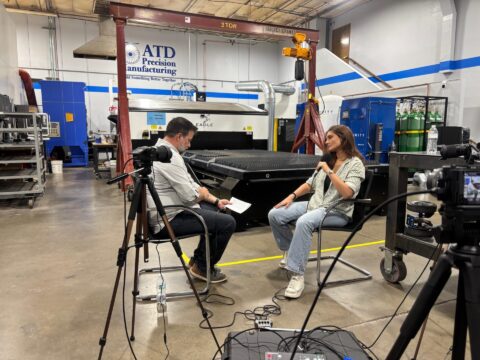

On a recent episode of The Manufacturing Executive Podcast, host Joe Sullivan sat down with Torrey, co-founder and CEO of AIC (America’s Innovation Corporation), to talk about what’s actually holding back the small component manufacturers that sit at the base of the most critical supply chains in the country — and what a former CIA intelligence officer thinks the fix looks like.
Torrey’s path to manufacturing acquisition ran through the intelligence community. After college, he was recruited by the CIA and served for several years, including a year in Afghanistan. He describes the agency in terms that sound indistinguishable from startup culture: a small group of highly motivated, mission-aligned people willing to run through walls. The experience taught him first-principles thinking, non-consensus analysis, and a worldview that everything the U.S. enjoys — military deterrence, technological leadership, quality of life — is downstream from the strength of its economy.
That conviction is what drives AIC. The company is a permanent holding company that acquires electronic and electro-mechanical component manufacturers — the shops that design and build the original components inside robotics, autonomous systems, and defense hardware. Torrey frames this category as “physical AI”: the shift from software that moves data to software that moves matter. And he believes physical AI is the technology that will define the next hundred years.
The shops AIC targets are typically founder-led businesses started 20 to 50 years ago by electrical or mechanical engineers. They own their IP. They do precision manufacturing. Their components end up in products made by primes and OEMs whose names everyone recognizes.
Torrey calls them national treasures, and he means it literally. The supply chain for physical AI can only move as fast as its base, and these small manufacturers are the base. They’re also the layer most starved for modern tools.
The numbers are stark. World-class manufacturing utilization, measured by overall equipment effectiveness, runs north of 90 percent. The high-mix, low-volume shops AIC works with are often running between 20 and 50 percent. The gap has nothing to do with talent or ingenuity.
It’s not a workforce issue. It’s a workflow issue. If you spend time on these shop floors, you will see there is tremendous amount of talent in the industrial base. The issue is having a suboptimal utilization — processes that are not optimal, from scheduling to production to inventory, hundreds and thousands of micro decisions that can be done in a significantly more optimal way.
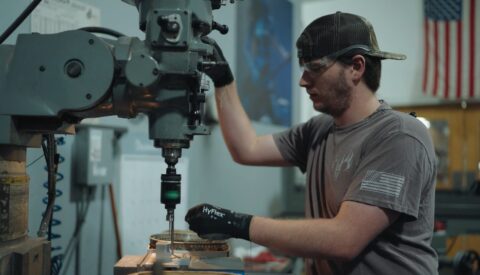
The decision-making infrastructure in these shops — how they handle inventory, scheduling, quality — was built for a world that no longer exists. Paper travelers. Clipboards. Tacit knowledge that lives in one person’s head. AIC deploys machine learning engineers and data scientists directly to shop floors to gather and contextualize that data, then builds proprietary software custom-fitted to each business.
Torrey draws a sharp line between what AIC does and what off-the-shelf SaaS products offer. A general-purpose software company is incentivized to build for the broadest possible market — the algorithm that’s good enough for a tire manufacturer, a hardware store, and a school cafeteria. That works. But it leaves significant value on the table for specialized manufacturers.
AIC’s software isn’t for sale. The only way to access it is by becoming a portfolio company. And the software is finished on the shop floor — what Torrey calls a commissary kitchen model. The base is prepared, the ingredients are ready, but the pizza gets its final customization on-site: specific algorithms, specific user interfaces, built for that business and no one else.
On the question of competing with China, Torrey rejects the framing entirely. The goal isn’t to match China’s volume. It never could be, and it doesn’t need to be.
Not all manufactured goods are created equal. Our goal is not to make as many Legos as possible. We want to make the most important Legos in the Lego set. It’s not out-produce China. It’s how do we outmaneuver dependence on China — supply chain sovereignty for the most strategically important technology programs.
The U.S. doesn’t need to manufacture everything. It needs to ensure it can manufacture the components that matter most without relying on a potential adversary. That’s a different problem with a different solution — and it starts with the small shops that most people have never heard of.
Torrey has sat down with close to 100 owner-operators, and he’s heard the same story from most of them. They believe they have two options when it’s time to step back. Sell to private equity, which in their mind means half the team gets fired, prices get doubled, and the business gets flipped in three years. Or sell to a large strategic acquirer, which means the brand disappears, production gets relocated, and everything they built gets absorbed into a catalog.
AIC pitches a third option: a permanent home. Fresh capital plus proprietary technology, a long-term horizon measured in decades rather than fund cycles, and a federation model where acquired businesses retain their autonomy, culture, brand, and identity. Torrey compares it to Berkshire Hathaway — portfolio support without centralized control.
His advice to owners thinking about transition: start the conversations now, with as many potential partners as possible. Selling a business is a one-way door. Most people only walk through it once. They owe it to themselves and the decades of work they’ve put in to understand every option available — including the one most of them have never been offered.