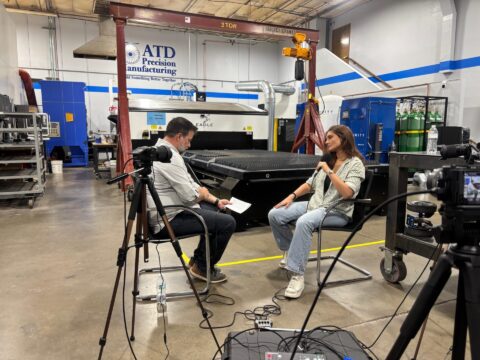

In a recent episode of the Manufacturing Happy Hour podcast, Miller dove into the three key themes of her book — meaning, optimism, and relationships — and why they matter just as much as the technical aspects of running a factory.
“What I talk about more with ‘More is Better’ is my framework for building excellence in industrial settings,” Miller explained. “It’s about meaning, optimism, relationships and leadership that naturally lead to excellent business results. And that’s true in excellent culture.”
So it’s part almost textbooky because I take, you know, what researchers, the organizational researchers have said. And I translate it to what I call real talk, usable tools for people who lead both on concrete and carpet.
The idea for the book grew out of Miller’s own journey. After a successful career in manufacturing leadership, including a stint as a general manager, she went back to school to study applied positive psychology. There, she was struck by the wealth of research on what drives organizational performance — and how little of it had made its way to the factory floor.
“I wanted to take the work of organizational researchers that, you know, are just brilliant, and they study what makes culture work,” Miller said. “So what are those principles? What is the science behind operational excellence from a psychological standpoint?”
The answer, she found, lies in three key areas. The first is meaningful work: helping employees connect their daily tasks to a larger purpose and set of values. The second is optimism: cultivating a belief that problems can be solved and setbacks overcome. And the third is relationships: fostering trust, psychological safety, and collaboration among team members.
For lean practitioners, the importance of optimism may be particularly resonant. At its core, lean is a problem-solving methodology — one that requires a willingness to confront challenges head-on and a confidence that solutions can be found.
“Optimism is really about that ability to look at when things go wrong and know that you can solve the problem,” Miller noted. “It’s temporary, it’s specific, and it’s not going to be the end of the world.”
So it’s not like a story, you know, read it and move on. I really hope it’ll be a reference for leaders at all levels in the industrial world.
But Miller is quick to point out that “More is Better” is more than just a collection of abstract principles. The book is designed as a practical guide, offering a “menu of interventions” that leaders can turn to when confronted with real-world challenges.
She’s even taken the unusual step of creating an AI-powered “More Mentor” tool on her website, moreforleaders.com. Users can pose scenarios and questions to the virtual coach, which draws on the book’s insights to offer tailored advice.
“It’s like having a little coach Kathy in your pocket,” Miller joked.
But the real power of the book’s ideas, she argues, lies in the cumulative impact of small, daily choices. Whether it’s finding a way to make one person’s job more meaningful, bringing an optimistic outlook to a thorny problem, or investing in a single relationship, the key is to start somewhere.
“Small choices really build our culture, our performance and our leadership legacy,” Miller said. “And that happens one little shift at a time.”
For manufacturing leaders looking to take their organizations to the next level, “More is Better” offers a fresh perspective — and a reminder that sometimes, the softer side of leadership can yield the hardest results.
“More is Better: Leading Operations with Meaning, Optimism and Relationships for Excellence” is available now. To learn more, visit moreforleaders.com, where you can also interact with the “More Mentor” AI coaching tool. For more from Kathy Miller, check out her previous appearance on the Manufacturing Happy Hour podcast in episode 97, where she discussed her book “Steel Toes and Stilettos.”