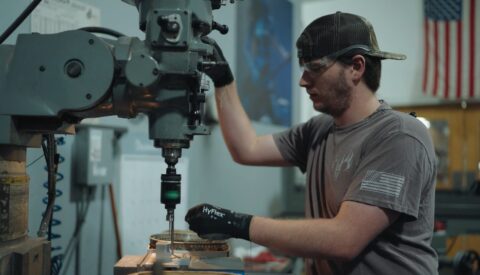

If you zoom out, the signal is consistent: investment, defense procurement, and industrial policy are converging around domestic production.
We often talk about manufacturing as a $2.3 trillion sector employing 13 million Americans across roughly 250,000 businesses — 99% of them small. What this week demonstrates is how those distributed networks are increasingly being activated.
Let’s break it down.
Durable Goods Orders Rise 1.8% — Capital Spending Holds
The Story
U.S. durable goods orders rose 1.8% in January, exceeding expectations and extending capital investment momentum into Q1.
Why It Matters
Durable goods are the heartbeat of industrial confidence. When orders rise, it signals that companies are still investing in equipment, machinery, and long-term production capacity. That demand flows directly into small and mid-sized suppliers — the tool-and-die shops, component manufacturers, and equipment builders that make up the long tail of American manufacturing.
The Bigger Picture
Capital expenditure resilience suggests that reshoring isn’t stalling despite cost pressures. Businesses are still getting after it.
Intel Commits $3.5B to Arizona Fab Expansion
The Story
Intel announced a $3.5 billion expansion of its Arizona fabrication operations, reinforcing continued domestic semiconductor buildout.
Why It Matters
Semiconductor fabrication doesn’t operate in isolation. Every fab expansion activates a deep supplier ecosystem — precision machining, specialty materials, industrial automation, advanced tooling. For small manufacturers positioned inside that network, this isn’t abstract policy; it’s purchase orders.
The Bigger Picture
Semiconductor reshoring has moved from aspiration to execution. The CHIPS framework is translating into concrete domestic capacity, and the ripple effects will stretch well beyond the fab walls.
$2.1B in New DoD Munitions Contracts Aimed at Broadening the Supplier Base
The Story
The Department of Defense awarded $2.1 billion in new munitions contracts with an explicit goal of expanding the domestic supplier base.
Why It Matters
This is about surge capacity. A resilient defense industrial base can’t depend on a narrow group of primes and single-source suppliers. Expanding participation means more small manufacturers entering the defense ecosystem — or re-entering it.
The Bigger Picture
Defense spending is increasingly aligned with distributed capacity building. That’s strategically significant. Manufacturing equals economic competitiveness equals national security.
Automakers Increase Domestic EV Component Sourcing
The Story
Automakers are increasing U.S.-based EV component sourcing amid tariff pressures and supply chain risk considerations.
Why It Matters
Supplier decisions in automotive ripple across regions. When sourcing shifts domestic, new relationships form — stamping shops in Michigan, electronics assemblers in Ohio, specialty metal processors in the South.
The Bigger Picture
Tariffs, resilience concerns, and logistics realities are reinforcing a structural shift toward regional supply chains. Optionality is becoming part of the sourcing equation.
Midwest Machine Shops See Surge in Aerospace & Defense Orders
The Story
Midwest machine shops are reporting rising aerospace and defense demand.
Why It Matters
This is the distributed model in action. Federal contracts don’t stop at the prime — they cascade through thousands of smaller suppliers who often know their customers personally and operate deeply relational businesses.
The Bigger Picture
When defense dollars reach local shops, it strengthens both economic vitality and national readiness. That’s the American model — networked entrepreneurship over centralized consolidation.
Around the Horn
-
Manufacturing PMI remained in expansion territory in February.
-
Commerce expanded advanced manufacturing tax credit guidance.
-
The Texas Manufacturing Outlook Survey showed production strength but continued margin pressure.
-
Small manufacturers reported growing order backlogs.
-
Additional CHIPS Act disbursements were announced.
Taken together, production remains firm — but cost pressure hasn’t disappeared. Small manufacturers are navigating both at the same time.
Closing
We are still in the first or second inning of a twenty- to thirty-year shift toward localized, resilient supply chains.
This week didn’t deliver a single dramatic headline. It delivered something more important — steady alignment between policy, capital, and distributed manufacturing capacity.
That’s how a renaissance actually unfolds.