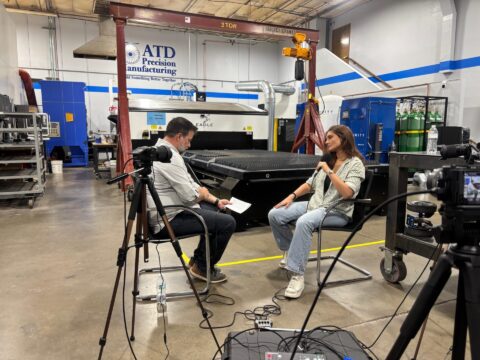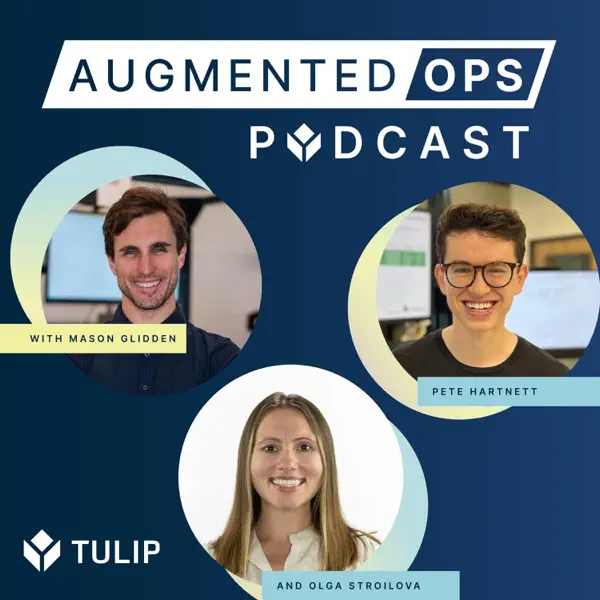

In a recent episode of the Augmented Ops podcast, Mason Glitt, Chief Product and Engineering Officer at Tulip, sat down with Product Managers Pete Harnett and Olga Strelova to explore the current state and future potential of AI in manufacturing. The conversation, coming on the heels of Tulip’s annual Ops Calling user conference, aimed to cut through the hype and skepticism to uncover the real opportunities for AI on the shop floor.
“Previously you might have had to be a data scientist with an AI/ML PhD,” Strelova noted. “Now you can go into chat with tables and just ask a few questions and get some awesome answers. That’s a lot less math involved these days.”
It feels like we’re at this kind of interesting precipice. Like Olga said, we’ve had these tools that can unlock these insights, but there’s a real gap in the ability to respond to them… With the advent of this agentic AI, AI that can start taking action, it feels like we have this kind of interesting moment to start closing that loop — take these insights and start proactively acting on them.
This notion of agentic AI — AI systems that can not only surface insights but act on them autonomously — is a key focus for Tulip as it evolves its platform. Harnett pointed to the example of machine sensor data: while it’s now relatively easy to stream real-time insights about equipment health and performance, acting on those insights still typically falls to human operators. Agentic AI could close that loop, automatically scheduling maintenance or adjusting production based on the data.
But for many manufacturers, the path from AI pilot to production has been rocky. Strelova highlighted a recent MIT study finding that 95% of generative AI pilots fail to prove ROI. She attributed this to challenges around data governance, adoption, and the need for clean, interpretable data that AI systems can reliably act upon.
Cultural factors play a role as well. “Whenever something new happens, it takes a bit of time to adopt,” Strelova noted. “So start small, build that culture of experimentation and innovation, and then scale when you feel comfortable.”
Glitt emphasized the importance of human validation and iteration in AI-powered processes. Just as Tulip’s human engineers are working collaboratively with AI to build better systems, he envisions a future where AI augments and empowers workers at every level of the operation.
We’re not replacing humans here. We’re supporting them. It’s sort of like one of those power suits in a superhero movie that you can now fly with — the Iron Man suit of agents.
Looking ahead, the Tulip team acknowledged the rapid pace of change in the AI landscape. Harnett advised manufacturers to invest in foundational capabilities that will improve as AI models become more sophisticated, rather than trying to predict the future.
Strelova added that preparing data for AI consumption and upskilling the workforce to leverage new capabilities will be key to success. “Let’s get that data clean. Let’s make sure any level of AI can use it,” she urged. “But also upskilling. Upskilling myself and my tech force, or upskilling your business to be able to leverage that new AI and know how to best use it.”
Above all, the group emphasized the importance of continuous experimentation and learning. “If you enjoyed the conversation, I encourage you to go ahead and subscribe to Augmented Ops, wherever you get your podcasts,” Glitt concluded. In a field as dynamic as AI for manufacturing, staying engaged with the latest innovations has never been more critical.
Augmented Ops is a podcast from Tulip Interfaces exploring the latest trends and technologies shaping the future of manufacturing. To learn more, visit tulip.co/podcast or subscribe on your favorite podcast platform.