
When it comes to artificial intelligence in manufacturing, there’s no shortage of hype — or pilots. It seems like every manufacturer worth their salt has an AI initiative underway, fueled by visions of smarter factories, streamlined supply chains, and superhuman quality control.
But for all the promise and potential, the reality is often a lot messier. Pilots stall out. Proofs of concept fail to prove much of anything. And for many manufacturers, the dream of AI-powered efficiency remains just that — a dream.
So what separates the AI winners from the also-rans? That’s the question that Joseph June, the Division Vice President and General Manager of Service Max and head of AI strategy at PTC, has been wrestling with for years. And as he sees it, the answer comes down to one thing: data.
“Folks that are successful actually have certain structural data that are available to them,” June explained on a recent episode of the Manufacturing Happy Hour podcast. “They understand data in terms of the nature of the data and where they’re located and what those data represent. Whereas folks that are stuck oftentimes are, maybe not as organized, like maybe some critical knowledge or data are in people’s minds and there’s a lot of tribal knowledge.”
What can an AI do that an individual cannot do? It can actually process a significantly large amount of data that you cannot do. Even if you’re a super experienced person, a subject matter expert within that particular company, you have a limited scope in terms of how much experience you can actually rely on.
In other words, it’s not enough to just have data — you need the right kind of data, structured in the right way, to unleash the power of AI. June calls this a “production data foundation,” and he argues that it’s the key to moving beyond pilots and proofs of concept to real, scalable impact.
But what exactly does a production data foundation look like? According to June, it’s not just about volume — it’s about value.
“Whenever PTC is talking about data foundation, that’s what we mean,” he said. “Because we think that there is an AI opportunity there. If a data represents individual decisions that people or group of people have made in effort to accomplish a specific goal or an outcome, that’s a really valuable data. And the reason is because I think we can use AI to learn the decision-making pattern based on that particular data.”
Of course, even the most robust data foundation won’t matter much if manufacturers don’t know what to do with it. That’s where June’s second piece of advice comes in: focus.
Too often, he argues, manufacturers try to boil the ocean with their AI initiatives, launching broad pilots that lack clear goals or metrics. The result is a lot of wheel-spinning and not much in the way of tangible results.
The solution? Start small and go deep.
“Pick something and go very deep on it, right?” June urged. “And being able to prove that out. I think that that’s a common mistake, because I think the potential for AI so tantalizing and, to be honest, elusive for so many, I think the goal that the expectations that they have and the way they approach it is just way too broad.”
Don’t expect to be able to do everything right off the bat. There’s a natural progression that you’re going to have to follow because not for the AI sake in my opinion, but for human sakes.
That progression, as June sees it, starts with advice — using AI to surface insights and recommendations that humans can then act on. From there, manufacturers can move to assistance, with AI taking on more of the heavy lifting but still keeping humans in the loop for key decisions and risk management.
Only then, once trust has been established and value proven, should manufacturers even think about full automation. And even then, June argues, the goal should be to empower humans, not replace them.
“AI, you can put that human in the loop in any one of those chains of sequences, any one of them, that’s really up to you, right?” he said. “Like, meaning that there is no AI system, in my opinion, I would actually execute things against your will. Like meaning that you could be very explicit about this is a recommendation that I’m going to get, and humans are going to take a look at that recommendation, and I’m going to make the final decision.”
It’s a vision of AI not as a job killer, but as a job enhancer — a tool for unlocking the full potential of human ingenuity and expertise. And for manufacturers who get it right, the payoff could be enormous.
“What’s unique about AI that’s different from a person, it is capable of processing on an incredibly large amount of data in a very faithful and ruthless way to be able to accomplish that particular outcome,” June said. “I think that people are going to be more informed than they’re going to be able to leverage data more effectively to be able to come up with a plan that they to be able to achieve the goals that they were trying to do.”
In other words? The factories of the future won’t be run by robots — they’ll be run by humans, turbocharged by AI. The only question is which manufacturers will be bold enough to build the data foundations to make it happen.
“I would say that AI, you can put that human in the loop in any one of those chains of sequences, any one of them, that’s really up to you, right?” June said. “There’s a human that basically owns that risk.”
For the manufacturers who are ready to own that risk — and reap the rewards — the future is wide open. The rest, well, they might just find themselves stuck in pilot purgatory a little while longer.
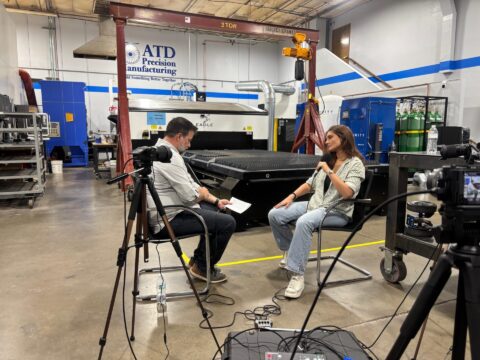
To learn more about how PTC is helping manufacturers build the data foundations for AI success, visit ptc.com. You can also hear Joseph June’s full conversation with Manufacturing Happy Hour host Chris Luecke on Apple Podcasts, Spotify, or wherever you get your podcasts.