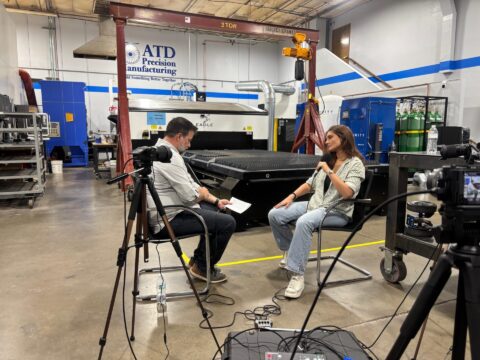
In a recent conversation on the Manufacturing Executive Podcast, DeKeyrel walked through what AI is already doing on factory floors, what’s blocking wider adoption, and where autonomous, multi-agent workflows are taking the industry next.
AI is already on the floor — and the bar to entry has dropped
DeKeyrel pointed to several practical applications that mid-size manufacturers can stand up today. Computer vision, a branch of AI, now sits inside cameras, mobile devices, and even Boston Dynamics’ Spot robots, watching for anomalies on production lines in places where human inspection is risky or impractical. The breakthrough, she noted, is that today’s vision models no longer require thousands of training images and a data science team. A single reference image of a good weld, paint job, or gasket is often enough for the model to flag deviations — and some manufacturers are running early proofs of concept with nothing more than an iPhone propped up beside the line.
Field service is another area where AI is already paying off. Scheduling, dispatching, work order creation, and on-site repair guidance can all be optimized by AI that knows which technician is closest, which has the right expertise, and what the asset’s failure history actually says. DeKeyrel cited IBM’s work with SUDO Technology, a large automotive enterprise in Beijing, where an intelligent knowledge graph and automated maintenance diagnostics cut average repair time by 31 per cent and training hours by 28 per cent.
AI being embedded on the floor like that with your technicians can help make every technician your best technician.
The barriers are data and tool sprawl
When asked what’s holding manufacturers back, DeKeyrel didn’t hesitate: data and tools. Most companies operate a patchwork of enterprise applications stitched together with ongoing integration work, and the data flowing through them is often incomplete. Work orders missing details about the issue, the fix, or the tools used create a “garbage in, garbage out” problem that no amount of AI sophistication can paper over.
Her recommended starting point is unglamorous but essential. For asset lifecycle management specifically, she suggests two foundational projects: a cleanup of work order history, and a consolidation of asset performance data — sensor feeds, SCADA systems, and similar sources — into the same repository as that work order data. With a single, trustworthy corpus in place, more sophisticated use cases become possible. IBM’s Maximo AI assistant now helps with this directly by flagging missing or incorrect data so teams know where to fix things first.
Generative AI as a force multiplier
Generative AI is already extending what asset lifecycle teams can do. In condition-based maintenance, it can perform root cause analysis when an asset underperforms, recommend whether to repair or replace, and assign the work to a specific technician. In work order management, it can generate orders, fill them out correctly, and shepherd them through to completion. It can also scan an entire backlog and find redundancy — DeKeyrel mentioned cases where companies had ten, fifteen, even fifty separate work orders scheduled for the same asset, which AI consolidated into one or two trips.
From single agents to chained workflows
The leap from generative AI to agentic AI is, in DeKeyrel’s framing, conceptually simple. An agent is a piece of software that does one thing well — verifying that a work order is complete, diagnosing an asset based on sensor data, or optimizing the technician schedule for the week. The power emerges when those agents are chained together into a workflow.
DeKeyrel described a near-future scenario in which agents continuously monitor factory floor assets, generate alerts based on subtle deviations rather than outright failures, hand the issue to another agent that drafts a work order and completes root cause analysis, pass that to a scheduling agent that picks the right technician, and meanwhile feed a separate agent crunching long-term capital planning data on repair-versus-replace decisions. Much of this work happens linearly today. Agentic workflows make it parallel.
AI agents are a type of system that can do these things we’re talking about — initiating workflows, performing autonomous tasks. They don’t have to be regularly prompted by users. They can do independent analysis and analyze data across and between different systems.
She drew a parallel to robotic process automation a decade ago, but called agentic AI “the big brother” of that earlier wave — broader in scope, more autonomous, and moving fast enough that mass adoption is likely within the next year or two.
What this means for people
DeKeyrel was candid that some roles, particularly those built around manual data entry, will shrink or disappear. But she expects a wave of new work to open up around monitoring agents for drift, retraining them on cleaner data, building new agents, and interpreting AI recommendations against business context. She pointed to one automotive customer that brought AI into its line without cutting any workers; instead, the company moved to 24/7 operations, with AI effectively running a third shift, and produced more with the same headcount.
The historical analogy she reached for was IBM’s own evolution. The same workforce that once operated typewriters and punch cards learned to use computers. Workers adapt as the technology shifts — provided their employers help them see it coming.
The closing advice: just start
DeKeyrel’s parting message to manufacturing leaders was direct. The biggest risk is paralysis — waiting for the perfect strategy, the right vendor, the cleanest data. Even an imperfect start produces learning that informs the next, better decision. Six weeks of action beats six months of deliberation. As she put it, become literate, consult experts, and get going.
The full episode is available on the Manufacturing Executive Podcast. Kendra DeKeyrel can be reached on LinkedIn, and additional resources on asset lifecycle management are available at ibm.com.