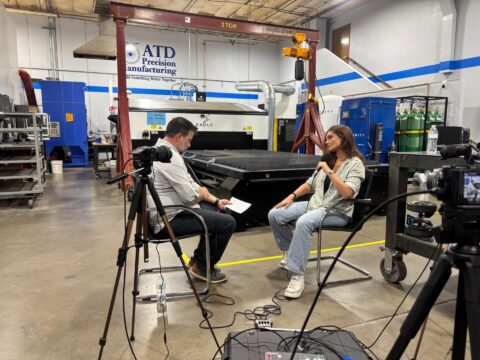

Chris Luecke has spent six years and 300 episodes interviewing manufacturing leaders from brewery barstools across the country. For the milestone episode, recorded live at Urban Chestnut Brewing in St. Louis, he flipped the script — handing the microphones to three high school friends and letting them do the grilling.
But before the roast, Luecke opened with a love letter to his hometown’s manufacturing ecosystem. Three local leaders — Joe Missola of McKenry Automation, Michael Eaton of the Missouri Association of Manufacturers, and Maria Barra of Made in Missouri — rattled off a roster of products most people don’t associate with the Gateway City: railroad ties made from recycled plastics, battery cells that power the Hubble Telescope, pepper spray manufactured in Fenton, and the pharmaceutical press molds behind everything from Flintstone vitamins to prescription medications.
The throughline wasn’t just product diversity. It was how St. Louis manufacturers work together. Eaton noted that the region’s collaboration-over-competition mentality is more pronounced than anywhere else in Missouri, with shops actively seeking out local partners rather than outsourcing to distant suppliers. Barra offered a concrete example: a manufacturer bringing a mold to a 3D printing company’s facility tour to explore whether they could produce it faster and cheaper together.
The second half of the show belonged to Pat Morris, Rob Garwitz, and John Petr — friends from Luecke’s days at De Smet Jesuit High School, none of whom work in manufacturing. Their outsider perspective produced the episode’s most candid moments.
Asked how he sustains the energy to tour a podcast like a concert series, Luecke pointed not to any manufacturing playbook but to DIY punk bands and travel bloggers. He launched Manufacturing Happy Hour in 2016 by asking a simple question: the industry has robots, automation, and cool technology — why isn’t anyone making content about it the way other industries do?
Everyone else is talking about artificial intelligence. Everyone else is talking about Industry 4.0. What are the things that you can talk about that are timeless, that highlight who you are, that highlight your expertise, that can allow you to stand out from the pack?
That philosophy — build your identity on something durable before chasing whatever technology is trending — has guided 300 episodes and counting. It’s also what Luecke says separates the best guests he’s interviewed from the rest. The leaders he admires most aren’t the ones hoarding the spotlight. They’re the ones who can articulate their own expertise while spreading credit across their teams.
The evening’s most memorable anecdote doubled as a leadership lesson. As a sophomore, Luecke played an 8 AM battle-of-the-bands set on a stage balanced on textbooks after a rainstorm. Mid-song, his leg went through the floor. He kept playing.
“That happens with every show, everything you do regardless of your career,” Luecke told the crowd. “Things don’t go according to plan, and in the moment you have to adjust.”
That willingness to absorb embarrassment — and keep going — is what his friends identified as his actual superpower. Not charisma or hustle, but a comfort with being laughed at that gradually hardened into the confidence to take real risks: leaving a corporate career, launching a media company, building a live-event circuit across the country.
The more you get used to doing little risks, the less those little risks feel like big risks. So then you can take the big leaps like starting your own company.
Luecke distilled two patterns from six years of interviews. First, servant leadership: the best manufacturing leaders showcase their own expertise while elevating the people around them. Second, regional thinking: the manufacturing ecosystems that thrive are the ones that expand beyond city limits — “all ships rise with the tide,” as Luecke put it — rather than guarding turf.
Luecke, expecting his first child this fall, was characteristically blunt about the road ahead. He’s not emotionally prepared for fatherhood — and says that’s the right answer. He built Manufacturing Happy Hour partly as lifestyle design, creating a platform where no one tells him when to get on a plane.
As for the industry, he sees renewed enthusiasm for building things, a shift back toward dignifying skilled trades, and a growing hunger for in-person connection in an AI-saturated content landscape. He plans to keep doubling down on live tours and brewery events — because, as he put it, how rude would it be to run a podcast with “happy hour” in the title and stop throwing parties?