
When Rosemary Coates founded the Re-Shoring Institute in 2014, the idea of bringing manufacturing back to the US was still a niche concept. Fast forward to today, and the landscape has shifted dramatically. Tariffs, geopolitical tensions, and a growing recognition of supply chain vulnerabilities have companies around the world rethinking their reliance on China — and eyeing alternative production locations.
But as Coates explained on a recent episode of the Augmented Ops podcast, the road to re-shoring is far from simple. And for all the momentum behind the idea, the US has yet to see a significant uptick in manufacturing job growth.
“Unfortunately — and we’re the Re-Shoring Institute, we would love to see manufacturing rebuilt here in the US — but the job growth in manufacturing in the US has been relatively flat for the entire year,” Coates said.
To a person, they told us absolutely nothing. These were all sort of medium-sized businesses, and what they told us was the economy and the tariffs were too unstable to make a decision. So they were making no decision. They were taking a ‘wait and see’ attitude.
That hesitancy, Coates argues, is rooted in a fundamental shift in how companies approach global manufacturing decisions. Gone are the days when cost was the sole driving factor, when executives would simply say, “Get me to China.” Now, the calculus is far more complex.
“Today, when I work with an executive, not only are we looking at the cost structure — that may be square one where you look at total landed cost or something like that,” Coates explained. “But on top of that, then you have to evaluate the geopolitics. What’s happening? Not just in China, but there’s all kinds of things that are happening in Venezuela, South America. These are all considerations that go into that decision.”
Add in factors like proximity to markets, access to skilled labor, infrastructure, and even climate change risk, and it’s no wonder that many companies are opting to hedge their bets by setting up production in multiple locations — a “China plus one” strategy, as Coates puts it.
But while diversification may be prudent, it doesn’t necessarily translate into a windfall for US manufacturing. The hard truth, Coates says, is that America simply can’t compete with the low labor rates found in countries like Mexico or Vietnam.
“Our labor rates can be as much as 10 times more than other countries,” she noted. “For example, we did a cross-border study just recently, which is published on our website. We looked at all the border cities in the US and Mexico and looked at the labor rates. For example, in San Diego, the labor rate is $17.65 per hour now, and right across the border in Mexico, it’s $2.59.”
If you have a lot of labor content in your production, that’s an important component of your overall cost structure, your costed bill of materials. Then looking to Mexico or another low-cost labor country is really important. The US just simply can’t compete.
That doesn’t mean, however, that the US is out of the game entirely. Coates points to sectors like semiconductors, pharmaceuticals, electric vehicle batteries, and rare earth elements as areas where the country is making strategic investments and could be poised for growth.
The key, she argues, will be for the government to take a more active role in shaping industrial policy — something that’s been largely absent in the US up to now.
“The US has no industrial policy, which when I found that out, I was really surprised,” Coates said. “I had no idea that we had not focused on any kind of manufacturing policy, but we haven’t in the past. We’ve let the market determine what to be manufactured and where.”
Now, with supply chain vulnerabilities laid bare by the pandemic and geopolitical tensions on the rise, Coates sees an opportunity for the US to chart a new course — one that prioritizes resilience and security alongside cost and efficiency.
“I think it’s really important for our government to lead and identify critical industries and help to fund those industries, which we sort of did under the Biden administration,” she said. “One of the first things they did was develop a study on supply chain vulnerability. And they came back with a list of, I don’t know, 25 or so industries that were really important.”
Whether the US can capitalize on that momentum remains to be seen. But for Coates, who has spent the better part of a decade evangelizing for re-shoring, the stakes have never been higher — or the opportunity greater.
“I’m very optimistic,” she said of US manufacturing’s future prospects. “You can see on the horizon that there’s growth.”
The question now is whether America will seize the moment — or let it slip away.
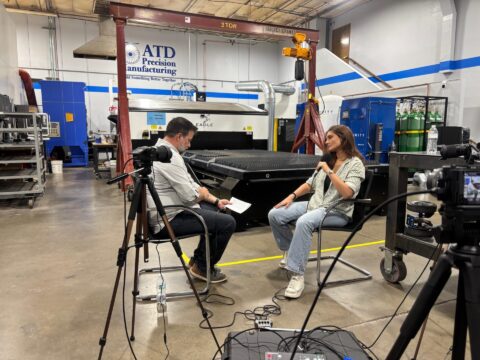
To learn more about Rosemary Coates’ work and perspectives, visit the Re-Shoring Institute website. You can also hear her full conversation with Madeline Castillo on the Augmented Ops podcast.