
If you’ve seen the flashy demos of humanoid robots doing parkour or busting dance moves, you could be forgiven for thinking the technology is still more sizzle than steak. But according to Colin Webb and Paul Baker, the era of real-world, production-ready humanoid robotics has already begun — and they’ve got the proof.
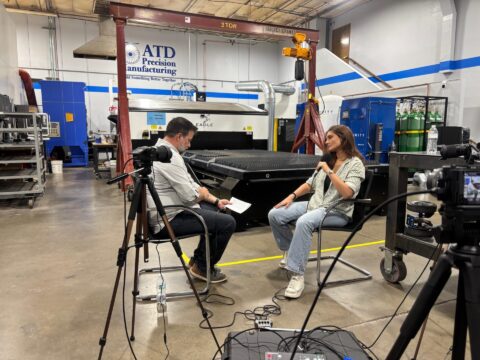
Webb, the founder and CEO of Avatar Robotics, and Baker, the CFO and co-owner of supply chain company Productive, are at the forefront of deploying humanoid robots in industrial settings. And as they explained on a recent episode of the Manufacturing Executive podcast, their focus is not on one-off spectacles, but on consistent, scalable performance.
“It’s different when it comes to the real world, right?” Webb noted. “It’s like, no, don’t just do this one or two times. Do it 10,000 times a day. Do it 20,000 times a day. And do it with 99% accuracy. That’s the real world.”
At Productive’s warehouses, Avatar’s robots are doing just that: kitting, picking, and sorting products at a pace and precision that’s driving measurable gains in throughput and unit cost. For Baker, it’s a capability that sets humanoid robots apart from more traditional forms of automation.
The savings in transportation has generally been available for a long time. It’s almost the one-to-one labor savings and headcount savings associated with picking and placing tasks, which is extremely unique and fits the humanoid form factor really well.
Looking ahead, both Webb and Baker see immense potential for humanoid robots to take on increasingly complex tasks in manufacturing environments. The key, they believe, will be advancing the robots’ ability to manipulate small parts and assemble components in tight spaces — a frontier that Avatar is actively pushing.
“I think everyone in manufacturing knows, like, they’ve already spent a lot of time thinking about automation,” Webb said. “And it’s like, okay, well, now you’re getting to that last mile piece of, okay, well, there’s this process that we either change all the time because the parts change, or there’s some nuance of it that it’s still manual today.”
I think the thing that unlocks it for manufacturers are being able to have technologies that get closer to the assembly process of being able to take smaller and smaller parts and kind of assemble them and place them into more confined and more restrained areas.
Of course, the rise of humanoid robotics raises questions about the future of human labor. But for Webb and Baker, the goal is not to replace people, but to elevate them. As robots take over repetitive, manual tasks, they see an opportunity to move workers into higher-value roles — a transition they’re already facilitating at Productive.
“Our goal would be, in the meantime, as we’re growing into that future, we are consistently looking to move people up along the way into higher-value roles as we go through it,” Baker explained.
Looking further out, Webb envisions a world where the rapid advancement of robotics and AI fuels entirely new categories of jobs and large-scale projects that are hard to imagine today.
“I think you’ll start to see this world of work transition to creating jobs, both robotic jobs, but then also manual labor jobs that we haven’t even imagined today,” he mused. “Things like building new infrastructure, building entirely new cities, building new transit, building entirely new data centers in space, or whatever you want to call it. That’s going to be at a scale that we haven’t even imagined.”
In other words, the humanoid robots of today aren’t just a novelty — they’re a glimpse of a rapidly approaching future. And if Webb and Baker have their way, it’s a future where robots and humans won’t just coexist, but thrive together.
“I think you’ll see a new world evolve that way,” Webb reflected. For manufacturers, the time to start preparing for that world is now.
To learn more about how Avatar Robotics and Productive are pioneering the use of humanoid robots in industrial settings, visit avatarrobotics.com and getproductive.com. You can also follow their progress on LinkedIn at Avatar Robotics and Productive Bank.