
Manufacturing has a talent problem. Two engineering professors think the fix starts with a student club, a company tour, and a succession plan.
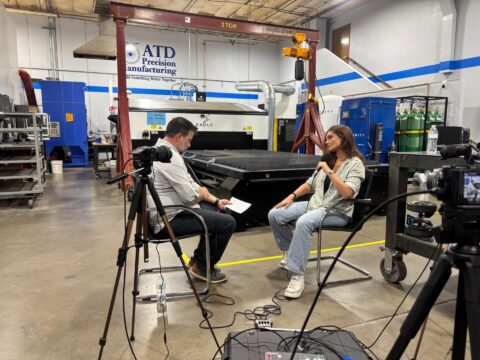
Dr. Bassem El-Sayed of Western Carolina University and Dr. Hakeem Altareki of Kent State University were recently named recipients of SME’s Distinguished Faculty Advisor Award. They joined the Advanced Manufacturing Now podcast to explain how they’re turning SME student chapters into pipelines for industry-ready engineers — and why more faculty should do the same.
Both advisors share a conviction: the most important development happens outside the lecture hall. Altareki, who founded Kent State’s SME chapter after students kept asking him about company visits and internships, put it simply: college isn’t just classes.
“Some of the most valuable learning happens outside the classroom,” he told host Michael McConnell. “There’s an entire world of experience that happens outside the classroom but within the college.”
A single student emailing a manufacturer for a plant tour gets ignored. A chapter advisor sending a request on behalf of 20 students gets a date on the calendar — and those visits convert directly into internships and job offers. One of Altareki’s students, still a year from graduation, already had three offers in hand.
When El-Sayed arrived at Western Carolina, he found an SME chapter that had been dead for nine years. Rather than rushing to restart it, he spent a full year building a sustainability strategy. The core idea: every student leader must groom a successor before their term ends.
There’s no point in starting the chapter if we don’t have a good strategy for sustainability. I ask every leader in the chapter to have a successor, scheduling him or her for the year. So by the end of the year, we already have the next group of leaders.
The approach worked. Founded in 2022, the chapter now has more than 50 members, earned SME Gold status, and produced university-level Leadership Excellence Award winners. El-Sayed is now exploring the formation of a professional chapter in the region — the nearest one is 200 miles away.
Altareki measures success not in membership numbers but in transformation. Students who join without confidence or industry exposure grow into leaders who organize events, mentor younger peers, and train classmates for SME certification exams.
After they spend a couple of weeks being a member, you can’t imagine the confidence level they’re going to get. Some of my students are now leaders — they know how to organize events, they know how to mentor younger students. Seeing this transformation, I can tell a student will succeed.
Both advisors stress empowerment over dependency. El-Sayed sends chapter leaders — not himself — to recruit in classrooms. Altareki steps back and lets students run meetings, plan fundraisers, and coordinate high school outreach. The advisor’s job is to guide, not to do.
Neither professor sugarcoats the time commitment. Weekly activities, conference travel, industry outreach — it adds up. But both argue the infrastructure already exists. SME provides annual chapter funding, administrative support, and a staff contact (both singled out a staffer named Jesse for going “above and beyond”) to walk new advisors through the petition and approval process.
“The wheel is invented — why reinvent it?” El-Sayed said. “Just leverage the structure.”
For Altareki, the pitch is even simpler: “You just have to have the passion for student success. Reach out to SME, and they’re going to help you out.”
Northeast Ohio, where Altareki is based, is a manufacturing hub hungry for talent. Western North Carolina, where El-Sayed works, has fewer industry neighbors but no less need. In both regions, these chapters are doing what career services offices and job boards cannot: putting students in front of working engineers, on factory floors, and into professional networks years before graduation.
The profession, El-Sayed said, “is in good hands” with these future engineers. The challenge is making sure more universities build the chapters to prove it.
This interview was originally published on the Advanced Manufacturing Now podcast by SME Media.