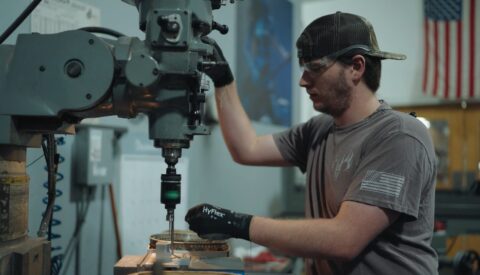

Bob Hellinger has been in the cutting tool business for more than thirty years. He has watched shops evolve from screw machine houses with cutting oil dripping off the ceilings to clean, climate-controlled facilities running fully robotic CNC equipment. The machines have changed. The materials have changed. The sophistication of the work has changed. What hasn’t changed fast enough is the pipeline of people qualified to do it.
Hellinger, the president and CEO of Emuge-Franken USA, spoke with Steve Plum on SME Media’s Advanced Manufacturing Now podcast about the state of the manufacturing workforce — what his company sees on the ground in central Massachusetts, why the German apprenticeship model hasn’t crossed the Atlantic, and what happens when demand outpaces the industry’s ability to staff its own equipment.
Emuge-Franken’s West Boylston, Massachusetts facility produces solid carbide cutting tools — end mills, drills, the precision instruments that go onto the CNC machines other manufacturers use to make parts. The company is a global operation headquartered in Germany, with production facilities in China, India, and Brazil, but the US plant is where Hellinger is trying to solve a local version of a global problem.
This October, the company hosted its Manufacturing Day event for the fourth consecutive year, expanding it to two days for the first time. Over 110 students and faculty from six trade schools visited the facility, filling the 45-person training center to capacity on both days. For many of the students — mostly high school juniors and seniors — it was their first time inside a manufacturing facility of any kind.
The visits serve a practical purpose beyond inspiration. Emuge-Franken needs those students. The company looks for two things in trade school graduates: solid math skills and some exposure to CNC programming. Beyond that, the real evaluation happens during summer and semester co-ops, where the question is more fundamental — will they show up, and are they interested in this kind of work? A trade school graduate who walks through the door is roughly three years away from becoming a fully competent machine operator. That’s a significant investment, and it only pays off if the person stays.
The trouble is that graduating classes from the area’s trade schools have essentially 100 percent employment by the time they finish. For any single employer, getting even one hire out of the pool is a competition. The problem isn’t the quality of the students coming out. It’s the quantity.
In Germany, Emuge-Franken runs a formal apprenticeship program that puts thirty or more young people through training every year. It functions as a reliable feeder pipeline for the company’s manufacturing workforce. Hellinger would love to replicate it in the United States. He’s tried. It didn’t work.
The issue is cultural, not structural. American workers are more mobile than their European counterparts. An employee trained through an apprenticeship program will leave for a dollar more an hour at the shop next door — or move two hours away for a better opportunity. In Germany, apprentices tend to stay with the company that trained them. In the US, that loyalty doesn’t hold, and the economics of investing years in someone’s development only to lose them to a competitor are brutal.
We train people through an apprentice program and then we lose them for a dollar more to the company next door. It’s different in Europe. They tend to stay with the companies that train them. And in the US, it’s not that way.
The generational shift is making it worse. Hellinger recounts a conversation with his own sons, both in their thirties, about job tenure. He told them he wouldn’t consider a resume from someone who had been at a job for only two or three years. They laughed at him. “Dad, you’re old-fashioned,” they said. “Everybody jumps within a few years.” Emuge-Franken’s existing workforce skews long-tenured — most employees have been with the company a decade or more — but replacing them with equally committed workers is becoming harder with each hiring cycle.
The workforce problem would be manageable if demand were flat. It isn’t. Hellinger came to the podcast fresh from IMTS, and his assessment of the market was unequivocal: in more than thirty years in the industry, he has never seen it this strong. Machine tool builders — Emuge-Franken’s primary customers — have no finished machines sitting on the floor. They are building to order and struggling to keep up. That is, in Hellinger’s words, “highly unusual.”
The demand is broad-based in a way that previous cycles have not been. Defense, commercial aerospace, space exploration, and oil and gas are all running hot simultaneously. Typically one sector drives growth while others lag. Right now, they’re all pulling at once. Emuge-Franken is predicting another strong year in 2027, perhaps not at 2026’s pace but still well above historical norms.
The company just took delivery of three new pieces of equipment. The next machine won’t arrive for at least six months. And every machine that comes through the door requires additional employees to run it — employees who are increasingly difficult to find.
I’ve been in this over thirty years. I have not seen it this strong in all the time I’ve been working. There’s a combination of defense industry, aerospace industry, space exploration, oil and gas. It’s a pretty broad-based growth, and we’re predicting 2027 to be another good year.
Hellinger is pragmatic about artificial intelligence. He doesn’t dismiss it, but he doesn’t see it replacing the skilled trades positions his company needs to fill. Emuge-Franken is already fully robotic on its production machines, and AI may well find applications in optimizing those operations. But the roles most likely to be affected in the near term are customer-facing — sales, marketing, accounting — not the machine operators, programmers, and tooling specialists who make the factory run. A person who understands what is happening on the machine, who can read the process and respond to it, is not something AI is poised to replace.
The workforce shortage in manufacturing is a problem with two sides, and both are worsening at the same time. On the inflow side, trade schools are doing credible work — they’ve upgraded from World War II surplus equipment to modern CNC machines, and they’re exposing students to real programming — but they simply aren’t producing graduates at the scale the industry demands. On the outflow side, baby boomers are retiring in large numbers, not just in the United States but across Europe, China, and every other market where Emuge-Franken operates. The institutional knowledge walking out the door with those retirements is not easily replaced, particularly when the replacement pipeline takes three years to produce a competent operator.
Hellinger expects the shortage to persist for the next five to ten years at minimum. His company’s response is to keep casting the net wider — more trade schools, more co-ops, more Manufacturing Day visits — and to retain the people it has through competitive wages and the kind of global exposure that a local shop can’t offer. Employees at the West Boylston facility travel to Germany for training. They collaborate daily with colleagues across the company’s international operations. The pitch is that Emuge-Franken offers something bigger than a job — it offers a window into a worldwide business.
Whether that pitch is enough to compete with the mobility and restlessness of a generation that considers two years at a company a full tour of duty remains the open question. The machines keep arriving. The orders keep growing. The seats in front of those machines are the constraint.