
April 2026 Manufacturing Insights
U.S. manufacturing continued to expand in April 2026, marking four consecutive months of growth and the strongest sustained run of factory activity since mid-2022. Both major purchasing manager surveys confirmed the upswing, though a closer look at the data reveals an expansion driven less by organic demand and more by urgent stockpiling as manufacturers brace for rising prices, supply chain disruptions, and the escalating impact of the Iran conflict.
Input costs surged to levels not seen in four years, according to ISM, employment continued to contract, and export orders weakened further. Meanwhile, billions of dollars in new factory investments announced during April underscore a broader realignment of U.S. manufacturing around AI infrastructure, defense, semiconductors, and domestic supply chain resilience.
A Month in Data
Both major purchasing manager indices confirmed expansion in April, though with important caveats about what is driving the numbers.
ISM Manufacturing PMI
The ISM Manufacturing PMI held steady at 52.7% in April, matching its March reading and its highest level since August 2022. The manufacturing sector expanded for the fourth consecutive month, while the broader economy continued its 18th straight month of expansion. According to ISM, the April reading corresponds to an estimated 1.8% increase in annualized real GDP.
The most striking figure was the Prices Index, which vaulted 6.3 percentage points to 84.6%, matching its April 2022 level and the highest reading in four years. Steel, aluminum, copper, plastics, petroleum-based products, and transportation costs all rose. This marked the 19th consecutive month of price increases. Meanwhile, new export orders remained in contraction at 47.9%, and supplier deliveries lengthened for the fifth straight month to 60.6%, signaling growing supply chain strain.
S&P Global Manufacturing PMI
The S&P Global US Manufacturing PMI jumped to 54.5 in April from 52.3 in March, its highest reading since May 2022 and a signal of the strongest improvement in factory conditions in nearly four years. However, S&P Global’s analysis made clear that the headline number overstates the health of the sector.
Output and new order growth were the steepest in four years, but both were commonly linked to stockpiling activity. Firms rushed to build inventories ahead of further feared price increases and supply shortages tied to the Middle East conflict. Purchasing activity rose at its sharpest rate since the pandemic, and pre-production inventories turned higher for the first time in three months.
Export orders fell for the 11th consecutive month, weighed down by tariffs and the war’s impact on international sales. Employment fell for the first time in nine months, and at the most pronounced rate in a year and a half, as firms chose not to replace voluntary leavers due to cost concerns. Both input and output price inflation accelerated to ten-month highs.
What the Data Means
Taken together, the April PMI readings reveal a manufacturing sector that is expanding but on uncertain footing. The key tension is between what the headline numbers show, growth at multi-year highs, and what is driving that growth. Both ISM and S&P Global point to stockpiling and front-loading of orders as major contributors, rather than a broad-based recovery in end-market demand.
This dynamic is reminiscent of early 2025, when tariff-related front-loading briefly inflated PMI readings before a pullback followed. The risk now is similar: if the stockpiling impulse fades, order books and production could soften in the months ahead. The persistent contraction in employment reinforces this concern. Manufacturers are choosing to reduce headcount even as output rises, a signal that firms view current production levels as temporary rather than the start of a durable upswing.
The geopolitical backdrop adds another layer of uncertainty. The Iran conflict has overtaken tariffs as the dominant concern among purchasing managers, disrupting shipping routes, energy markets, and raw material supply chains. While some firms expressed cautious optimism that the U.S. economy may be less affected than initially feared, the balance of sentiment remains decidedly negative.
New Factory and Manufacturing Announcements
Despite the headwinds reflected in the survey data, April 2026 saw a wave of major manufacturing investment announcements across the United States. Spanning defense, AI infrastructure, pharmaceuticals, steel, food production, and renewable energy, the month’s projects represent billions in capital spending and thousands of new jobs. These investments point to a longer-term structural shift in where and what the U.S. manufactures, even as short-term conditions remain volatile.
L3Harris: $1 Billion Defense Expansion in Virginia
L3Harris Technologies announced a more than $1 billion expansion of its solid rocket motor production site in Orange County, Virginia. The project will more than double manufacturing space and create over 350 jobs, supporting output for key national defense programs at a time when defense-related manufacturing is gaining momentum across the country.
AbbVie: $1.4 Billion Pharmaceutical Campus in North Carolina
AbbVie committed $1.4 billion to build a 185-acre pharmaceutical manufacturing campus in Durham, North Carolina, its largest capital investment to date. The facility will produce medicines across immunology, neuroscience, and oncology, creating 734 jobs and expanding domestic drug manufacturing capacity in a state that continues to attract major life sciences investment.
U.S. Steel: $1.9 Billion Direct Reduced Iron Facility in Arkansas
U.S. Steel announced a $1.9 billion investment to build a first-of-its-kind direct reduced iron facility at Big River Steel Works in Osceola, Arkansas. The project aims to create a fully vertically integrated domestic steel operation, from Minnesota iron ore to Arkansas finished steel, and is expected to support about 200 full-time employees along with roughly 2,000 construction jobs at peak.
Ferrara Candy: $675 Million Manufacturing Facility in South Carolina
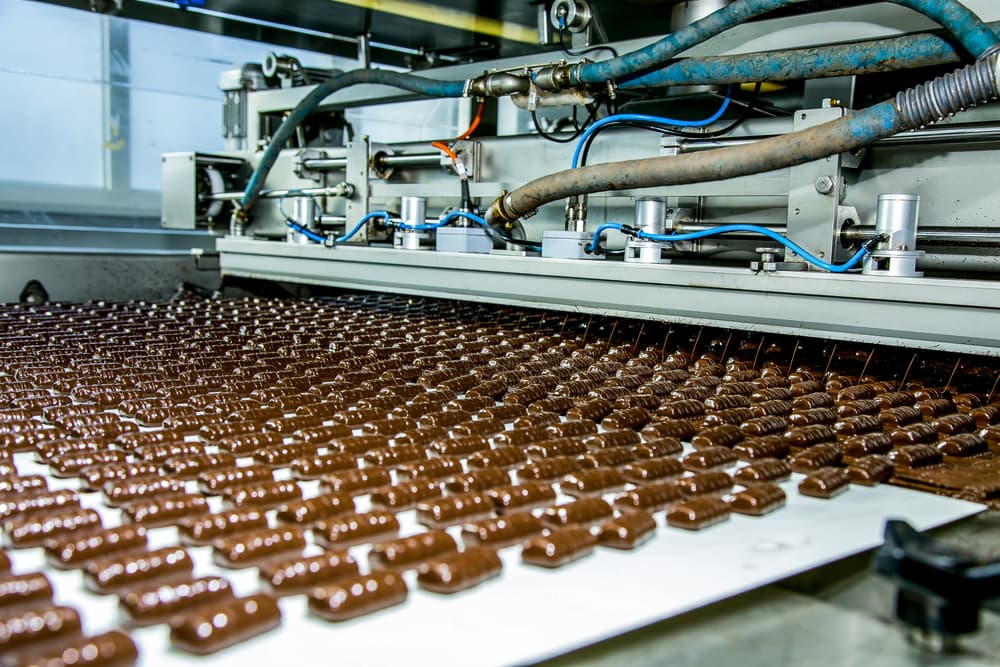
Ferrara Candy Company announced plans for a 750,000-square-foot manufacturing facility in Orangeburg County, South Carolina. The $675 million project will create 1,000 jobs and support processing, packaging, and distribution operations, representing a major expansion of the company’s manufacturing scale.
Eaton and Applied Optoelectronics: AI Data Center Infrastructure
Two notable projects highlighted the continued buildout of AI-related manufacturing. Eaton announced a 370,000-square-foot facility in Bellevue, Nebraska, to produce medium-voltage switchgear for data centers, creating over 200 jobs. Applied Optoelectronics expanded its Houston-area operations by nearly 388,000 square feet to produce optical networking products for high-speed AI data center connectivity.
Future Outlook
April’s data presents a manufacturing sector at an inflection point. The expansion is real, but its sustainability depends on whether underlying demand can replace the stockpiling impulse as the primary growth engine. Several dynamics will shape the trajectory in the months ahead.
The cost environment is the most pressing near-term concern. With the Prices Index at its highest level since April 2022 and supplier deliveries continuing to lengthen, margin pressure will intensify across the supply chain. Manufacturers reliant on imported materials face an especially difficult pricing environment. Companies should be revisiting supplier contracts, diversifying sourcing, and considering strategic inventory builds where feasible.
The geopolitical situation remains the largest wildcard. The Iran conflict is reshaping energy markets, shipping routes, and raw material supply chains in ways that are still unfolding. While S&P Global’s survey found some optimism that the U.S. may be less affected than other economies, the conflict was cited in nearly half of all ISM respondent comments, and its effects on fuel costs, electronic component availability, and transportation pricing are broad-based.
On a more encouraging note, the wave of factory investments announced in April signals enduring confidence in U.S. manufacturing’s long-term trajectory. The continued buildout of AI infrastructure, semiconductor capacity, defense manufacturing, and domestic steel production represents a structural realignment of the industrial base toward high-growth, strategically important sectors. Customer inventories remain at levels ISM characterizes as “too low,” which is typically a positive signal for future production.
The next several months will be telling. If the stockpiling-driven boost fades without a corresponding pickup in organic demand, the sector could see a pullback in production and orders similar to the post-tariff front-loading correction of early 2025. However, the depth and breadth of capital investment in new domestic manufacturing capacity suggests that the longer-term trajectory for U.S. industry remains upward, even if the path forward is anything but smooth.