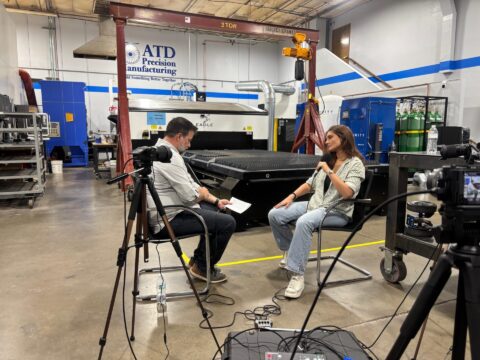

On a recent episode of The Manufacturing Executive Podcast, host Joe Sullivan sat down with Sahni, who was appointed CEO of Xometry in July 2026, to talk about why the custom parts industry is stuck in an offline world and what it will take to pull it forward.
Sahni’s argument isn’t that American machine shops lack capability. It’s that the process surrounding that capability is broken. An engineer can design a part in an afternoon using modern CAD tools. But then the work stalls — manual RFQs sent out, days of waiting, hoping that the shop on the other end has the right materials, tolerances, and capacity. The hidden miss rate is high. The feedback loop is slow. And the entire system runs on relationships and geography rather than data.
Xometry’s pitch is to replace that process with what Sahni calls the “digital infrastructure for custom manufacturing” — a platform that can price a part instantly using historical production data, assess manufacturability, flag design-for-manufacturing issues, and match the job to a qualified partner in real time.
The company has been applying machine learning to pricing since its founding 13 years ago, converting 3D models into geometric representations and running them through data science models trained on millions of produced parts. Now it’s extending that AI layer to the partner side, personalizing which jobs surface first when a shop owner opens the app based on their machines, job history, and preferences.
For most of the industry’s history, machine shops have operated within a 30- to 50-mile radius of their customer base. A few big accounts in the region, relationships built over years, work driven by proximity. Sahni says that model is dissolving.
He points to what he’s seeing on the ground: oil and gas shops in Houston picking up aerospace work. Automotive shops in Michigan producing medical device components for companies in California. The jobs are finding the capability, regardless of where it sits.
We are no longer bound by the 30, 50 mile radius phenomena that has forever existed. I’ve seen shops in the Houston area do work for the aerospace industry, shops in Michigan do medical devices for companies out of California. The kind of jobs those shops are getting, the kind of outcomes they are able to deliver — that’s completely changing.
The shift has a consumer-grade dimension, too. Xometry launched a mobile version of its WorkCenter app for manufacturing partners — one of the first marketplaces, Sahni notes, to build a partner-facing mobile app before a customer-facing one. The reasoning is practical: a five-person shop can’t keep running back to a desktop between jobs. Partners now accept work, upload in-process photos, and monitor new opportunities from the shop floor. One partner told Sahni he can’t sleep anymore — not from stress, but because he checks the app at night to see if new jobs have posted.
The deeper play is about what kind of business a machine shop can become. Sahni makes a point of calling manufacturers “partners,” not suppliers — equal participants on both sides of the marketplace. And he’s deliberate about what Xometry should handle versus what the shop owner should focus on.
Most people who start machine shops, he observes, do it because they love making things. Not because they want to run marketing campaigns or cold-call potential customers within driving distance. If the platform can handle sales, marketing, job matching, and even serve as a basic MES for managing production, the shop owner can stay focused on what drew them to the trade in the first place.
Most of the partners that I meet that started a machine shop, they started a machine shop because they enjoy and love the act of actually making something. I want to make sure that they actually don’t have to think about who will I canvas in the 30, 50, 100 mile radius. I want them to actually just focus on what they love doing.
To keep that promise honest, Sahni says he spends his Fridays visiting partners in the Houston area, asking what Xometry isn’t doing right. The list of things he’s heard includes support for finishing and post-processing, access to specialty aerospace materials, and better integration with partners’ own production workflows.
Earlier this year, Xometry announced a strategic partnership with Siemens to embed its pricing and intelligence engines directly into Siemens’ design software. The goal is to close the last gap in the CAD-to-part workflow: an engineer working in their design environment can get an instant price, find a manufacturing partner, and place an order without leaving the tool.
It’s a bet that the future of custom manufacturing procurement won’t start with an RFQ at all. It will start inside the design file.
Sahni describes Xometry’s proprietary dataset — 13 years of production data on millions of custom parts — as something that doesn’t exist in the public domain. You can’t train a general-purpose AI on custom parts manufacturing because the data isn’t out there. That gives Xometry both an advantage and what Sahni calls “a burden of commitment” to use what it knows to improve the broader industry.
His near-term priorities are straightforward: keep applying AI to improve both sides of the marketplace, bring large enterprises onto the platform, and push online penetration in a category that’s barely begun the shift every other industry completed years ago. At less than one percent, there’s a long way to go. But if the pattern holds — and books, electronics, and home goods suggest it will — the direction isn’t in doubt. The only question is speed.
For a platform built on the premise that speed is everything, that’s a fitting challenge.