If you want to understand where American manufacturing is headed, this week’s numbers are worth paying attention to.
$4 billion. $1 billion. $890 million. $50 million.
Those are just a few of the investments announced or completed across American manufacturing this week. Semiconductor memory is coming to Indiana. Steelmaking capacity is getting a major investment in Ohio. Caterpillar is putting hundreds of millions into its Lafayette, Indiana, engine operation. Raytheon is expanding defense manufacturing in Mississippi.
These aren’t abstract policy announcements. They’re factories, equipment, workers, suppliers and communities.
And that’s what makes this moment interesting.
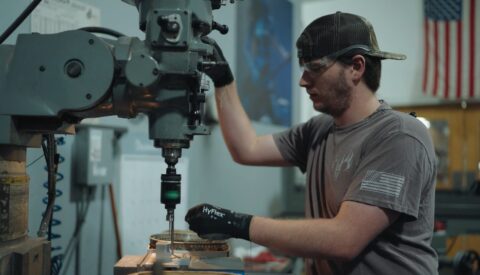
The American manufacturing renaissance isn’t going to be built by one giant factory or one government program. It’s going to be built by thousands of companies that have to work together: the machine shop making a precision component, the electronics supplier supporting a defense program, the logistics company moving material, the software provider helping everyone coordinate, and the workers whose expertise makes the whole system function.
This week’s headlines show both sides of that equation.
Capital is moving into American manufacturing. But connecting that new capacity into a resilient network remains the harder mission.
$4 Billion Bet on American AI Infrastructure
The Story: SK hynix broke ground in Indiana on a new advanced-packaging production facility for high-bandwidth memory, or HBM, used in AI computing. The company says it will invest more than $4 billion, with mass production of next-generation HBM targeted for the second half of 2029. It expects the project to create approximately 7,000 direct and indirect jobs and establish an ecosystem involving more than 100 partners. SK hynix is also working with Purdue University on next-generation advanced-packaging research.
Why It Matters: The important number may not actually be $4 billion.
It’s the 100-plus partners.
Advanced manufacturing is never just one facility. It is an ecosystem of suppliers, engineering firms, equipment companies, universities, logistics providers and specialized manufacturers. The ability to build those relationships efficiently will increasingly determine how quickly new domestic capacity can scale.
That is particularly important for the thousands of smaller manufacturers that make up the long tail of American industrial capability. They don’t need to become semiconductor companies. They need to become discoverable to the companies building the semiconductor ecosystem.
That’s where technology can become a force multiplier—not by replacing relationships, but by making it easier for the right companies to find one another.
America Is Reinvesting in the Industrial Base
The semiconductor story is getting most of the attention, but the broader manufacturing picture is even more interesting.
Cleveland-Cliffs plans to invest $1 billion over four years at its Middletown, Ohio, steel facility, including a blast-furnace reline, material-handling upgrades and AI-enabled control technology.
Caterpillar is planning another $890 million at its Large Engine Center in Lafayette, Indiana, where just under 2,000 people work. The plan includes approximately $540 million in machinery and equipment and $350 million in facility improvements.
And Raytheon just completed a $50 million, 17,000-square-foot expansion in Forest, Mississippi, increasing production capacity for electronic-warfare and radar systems and supporting an expected 100 new high-skill jobs by 2028.
Caterpillar’s and Cleveland-Cliffs’ investments were reported during the week.
The point is that reshoring isn’t just about bringing back final assembly. It is about rebuilding the underlying industrial capabilities that make everything else possible.
Steel. Engines. Electronics. Semiconductor packaging. Defense systems.
Those capabilities matter economically, but they also matter strategically. A country that cannot produce critical things at scale has less optionality when the world gets complicated.
And the world is getting complicated.
The Supply Chain Is Still Vulnerable to Policy Shocks
The week’s trade news provided a useful reminder that localization doesn’t happen in a vacuum.
The United States moved toward a 50% tariff on Canadian cars, trucks and automotive parts beginning Jan. 1, 2027, following the breakdown of U.S.-Canada trade negotiations. Reuters reported that Canadian-built vehicles represented about 6% of U.S. vehicle sales in 2025.
Honda subsequently said it may not move forward with another North American assembly plant without greater clarity around the future of the USMCA trade agreement. The company says it will need additional North American capacity around 2030.
This is the part of reshoring that deserves more attention.
A supply chain isn’t a collection of isolated factories. It is a network that has been optimized over decades. Change one major variable—tariffs, labor costs, transportation, regulation or geopolitical risk—and the economics of the entire network can change.
That doesn’t mean companies should ignore cost.
It means cost is no longer the only variable that matters.
In an uncertain world, you need optionality.
The Small-Manufacturer Bottleneck
There is another part of this week’s news that may ultimately matter even more: whether America’s smaller manufacturers can participate in the rebuilding of the industrial base.
The Department of Defense delayed Phase 2 of its Cybersecurity Maturity Model Certification program while it reviews the framework. Phase 1 remains in effect, and experts continue to advise defense contractors to keep working toward compliance.
The scale is significant. More than 120,000 small defense-industrial-base businesses could potentially be affected by the requirements, while compliance costs for some small firms can run into hundreds of thousands of dollars.
At the same time, a federal audit questioned $20.9 million in costs associated with Ohio’s Manufacturing Extension Partnership program and identified $2.8 million in underreported income.
None of this diminishes the importance of cybersecurity or manufacturing-support programs.
It highlights the challenge.
If America wants a broader and more resilient manufacturing base, the system has to work for the 50-person machine shop, not just the prime contractor.
The goal should be to make it easier for capable small manufacturers to qualify, connect, grow and participate—not create so much administrative friction that they decide defense work isn’t worth pursuing.
That’s particularly important because distributed capacity is one of America’s structural advantages.
Around the Horn
$131.23 billion: The Air Force awarded Boeing a contract with a $131.23 billion ceiling covering production, modernization and sustainment of F-15 aircraft through 2037. Importantly, this is a contract ceiling rather than a commitment to spend the entire amount; only $343,740 was obligated at award.
10,000: Approximately 10,000 UAW members at Deere rejected a proposed contract extension, leaving the existing agreement in place through its current October 2027 expiration.
10x: Hyundai plans to expand its Robot Metaplant Application Center by more than tenfold by the end of 2026 as it develops its robotics business.
$3B+: Lam Research is expanding its global laboratory network with more than $3 billion in planned investment over five years, including a new research facility in Oregon.
The Renaissance Is an Ecosystem
The headlines this week are encouraging.
Billions of dollars are flowing into American factories. Companies are expanding semiconductor, steel, engine and defense capabilities. Communities across the country are seeing new investment and high-skill manufacturing opportunities.
But the factory is only the beginning.
The real competitive advantage comes from what happens around it.
Can a new semiconductor facility quickly identify the 50-person manufacturer capable of producing a specialized component? Can a defense prime bring more commercial manufacturers into its supply chain? Can a small supplier meet cybersecurity requirements without spending more on compliance than it can afford? Can companies build enough trusted relationships to maintain optionality when the next disruption arrives?
Those are the questions that will determine whether this becomes a genuine renaissance of American manufacturing.
The United States doesn’t need to copy China’s model of massive vertical integration. It can lean into its own advantage: a deeply relational industry made up of thousands of entrepreneurial businesses that know how to build things and know how to work together.
We’re still early in what could be a twenty- or thirty-year shift toward more localized manufacturing supply chains.
The capital is moving.
Now we need to make sure the network is ready.