
As artificial intelligence and advanced automation become increasingly central to modern manufacturing, the industry faces a pressing question: Who will operate these technologies, and how will they learn to do so?
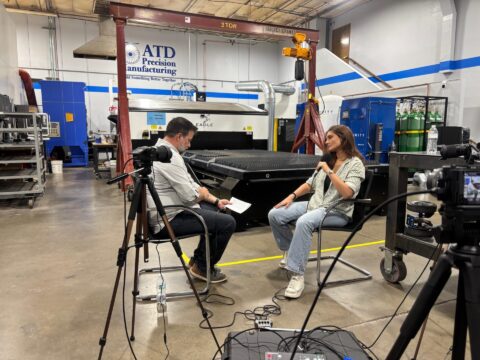
That’s the challenge at the heart of the latest issue of Advanced Manufacturing Now, SME’s monthly podcast and magazine exploring the cutting edge of the industry. In a recent roundtable episode, the publication’s editors — Steve Plum, Amy Bryson, Carrie Haveart, Rachel Talmos, and Mike McConnell, along with star contributing editor Kip Hanson — unpacked a range of initiatives aimed at bridging the skills gap and preparing the next generation of manufacturers.
The cover story, penned by Karen Haywood-Queen, surveys the landscape of workforce development efforts, from technical colleges and apprenticeship programs to “micro-credentials” that help workers quickly upskill in specific areas.
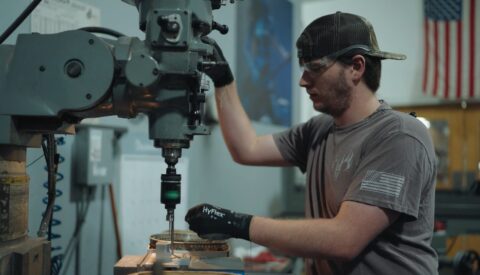
One success story comes from Grob Systems, a maker of precision machine tools, where a young apprentice named Ethan is thriving in a hands-on learning environment. “Ethan says he’s getting the hands-on education that he really wanted,” Bryson recounted. “And everything he learns is practical, it has a real-life application, and it has a purpose.”
And while Ethan’s just beginning his journey, Grob’s retention is really impressive. They have a completion rate of 91% finishing four years. And in fact, 35% of Grob’s North American total workforce is former apprentices. And nearly, they make up even half of the skilled trades and technical positions.
Another untapped talent pool, McConnell argued, lies in America’s veteran population. Many service members struggle to translate their military experience into civilian careers, despite having highly relevant skills and work ethic. The challenge, he suggested, is simply connecting veterans with manufacturing employers who will value what they bring to the table.
Haveart, meanwhile, highlighted a major investment by Textron Aviation to consolidate its workforce development efforts under one roof. The company’s new $40 million Career Learning Center in Wichita spans 100,000 square feet, with dedicated zones for recruitment, onboarding, technical training — even a simulated factory floor and a K-12 outreach program complete with a Cessna flight simulator.
But even as manufacturers work to attract and train new talent, they’re also grappling with the transformative potential of technologies like the industrial internet of things (IIoT), AI, and multi-axis machining.
Plum pointed to the increasingly data-driven nature of modern shop floors, where sensors and software are replacing the old-school “andon lights” as the primary means of monitoring machine performance. The upside is a wealth of data that can be used for process improvement and predictive maintenance — but harnessing that data effectively requires new skills and a willingness to embrace change.
Back in the day, you’d walk out on the shop floor, you’d see the andon lights — the red, green, yellow lights on top of the machine — and if they’re all green, it’s good. But the industrial internet of things, IIoT, is kind of replacing that old-school way of thinking. Shops are becoming increasingly data-driven based on the input they get from their machine tools and their machine controls.
Hanson echoed that point, noting the learning curve that comes with advanced technologies like five-axis machining centers. While these machines can dramatically streamline production by eliminating downstream operations, they also require more complex programming and a workforce that’s adept at both milling and turning.
The key, argued Jake Oaken, an instructor at Arizona State University and one of SME’s 2025 “30 Under 30” honorees, is to start exposing students to these technologies early and often. In a column for the issue, Oaken described the sense of curiosity and creativity that emerges when his students encounter tools like 3D printing, robotic dogs, and generative design software.
“We’re at a time when technology and creativity are genuinely coming together,” Oaken wrote. “The blend of AI, robotics, and human-centered design is transforming how we build, think, and approach solving real-world problems.”
For manufacturers looking to stay ahead of the curve, the message is clear: investing in your human capital is every bit as important as investing in your physical and digital infrastructure. Because even the smartest factory is only as good as the people who run it.
To hear more insights from the Advanced Manufacturing Now team, check out the full episode on SME’s website or wherever you get your podcasts. And if you know a manufacturing rising star under the age of 30, keep an eye out for SME’s 2026 “30 Under 30” nominations, opening this month.