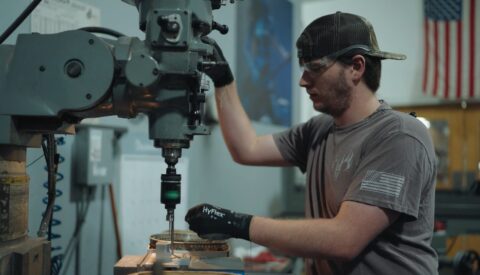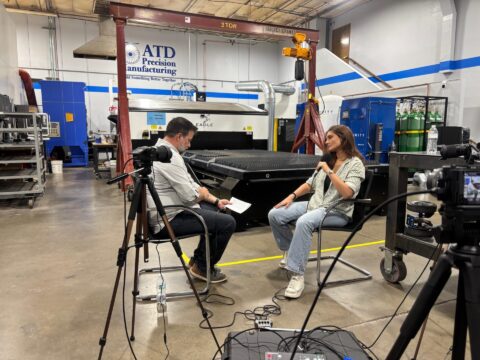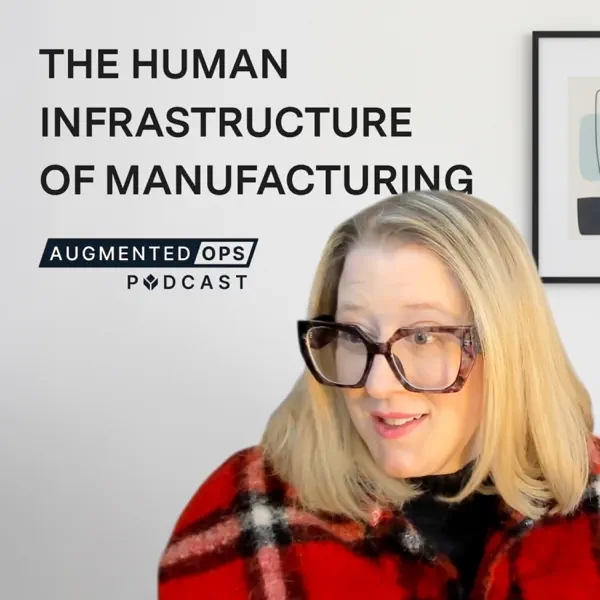

When we talk about infrastructure in the manufacturing world, we usually mean the physical stuff: the factories, the machines, the roads and bridges that carry our goods. But according to Stacey Weismiller, founder of the newly launched American Manufacturing Future’s Institute (AMFI), we’re overlooking a critical component: the people who make it all work.
“I believe that a lot of the work that I was put here to do is around making sure that our vision for advanced manufacturing, our vision for the industrial ecosystem, is really powered by three key things: people, policy, and place,” Weismiller said in a recent episode of the Augmented Ops podcast.
It’s a perspective born of Weismiller’s unique background. Raised in a manufacturing family in Erie, Pennsylvania — “Manufacturing has always been in my blood,” she notes — Weismiller initially set out to study architecture and urban design. Her goal: to build not just buildings, but systems that could drive economic development and human flourishing.
I was never really hyper-focused on wanting to build a building. I wanted to build systems, which is very strange, because then when you do work in manufacturing, what you realize is it’s a system.
That systems thinking is at the heart of AMFI’s mission. The organization, which launched officially just last week, is founded on the premise that “people power manufacturing” — that human capital is the foundation of industrial resilience.
For manufacturers, that means grappling with the constant tension between efficiency, productivity, and human factors. In a world obsessed with KPIs and benchmarks, there’s little room for the “emotional intelligence” that Weismiller sees as essential.
“We consistently want people to plug into these very rigid systems, but what we don’t recognize is that they’re dynamic,” she explained. “They’re not just pumping out product, but they also have an emotional intelligence which does allow them to feel and see and be different.”
The key, Weismiller argues, is to start seeing that dynamism as an asset, not a liability — to recognize that investing in people is just as important as investing in technology or equipment.
That’s especially true as the industry grapples with the rise of artificial intelligence, which Weismiller sees as a powerful tool for augmenting human capabilities, but one that raises thorny questions about access and equity.
“AI is a tool where we can see that it can be extremely powerful in the augmentation of the industrial ecosystem,” she said. “It’s augmenting the power of people. It’s also, quite frankly, really helping ensure quality assurance and reduce defects. It’s actually, when used appropriately, can be very helpful from the human side on a factory floor in the industrial operation.”
But that’s also the problem in a lot of ways, because how do we ensure that that’s how it’s being used? That’s the goodie bag, which is like, you can fill it full of a bunch of sugar and suckers, and certain kids maybe have one sucker and know that that’s too much sugar, and everyone else binges on it because there’s the tragedy of the commons, everyone wants more. And so how do we ensure that as AI gets deployed, it’s being deployed appropriately and not being used in a way that’s harmful?
For Weismiller, the answer lies in what she calls “civic manufacturing” — the idea that manufacturers have a responsibility not just to churn out products, but to play an active role in supporting the communities in which they operate.
“I believe in civic manufacturing, which is simply saying that yes, you’re making a product, that product might go all over the world, but you’re making it in a community, and you need to be playing a role as a civic entity to ensure that you are part of the community,” she said.
That means things like investing in workforce development, supporting local suppliers, and working to build manufacturing ecosystems that create opportunities for everyone — not just the shiny new startups, but the legacy producers and line workers who have long formed the backbone of the industry.
It’s a tall order, but Weismiller is confident that it’s not only possible, but essential for the future of American manufacturing. And she’s inviting anyone who shares that vision to join the cause.
“If at any point in your day you come across your iPhone, you drive in your car, you take your Advil, you’re driving on a road to drop your kid off at school — think about this holistically, not just the products that you’re using, but the space that you are also taking up, because manufacturing has played a role in that,” she said. “And if at any point you want those things to be better, smarter, and have a higher density of emotional intelligence and how it affects you in your community, find me. Because that is what we’re going to try to build.”
To learn more about the American Manufacturing Future Institute and its mission to put people at the center of the industrial ecosystem, visit AMFI’s website or connect with Stacey Weismiller on LinkedIn. You can also hear her full conversation with Augmented Ops on the Tulip Interfaces podcast or wherever you get your podcasts.