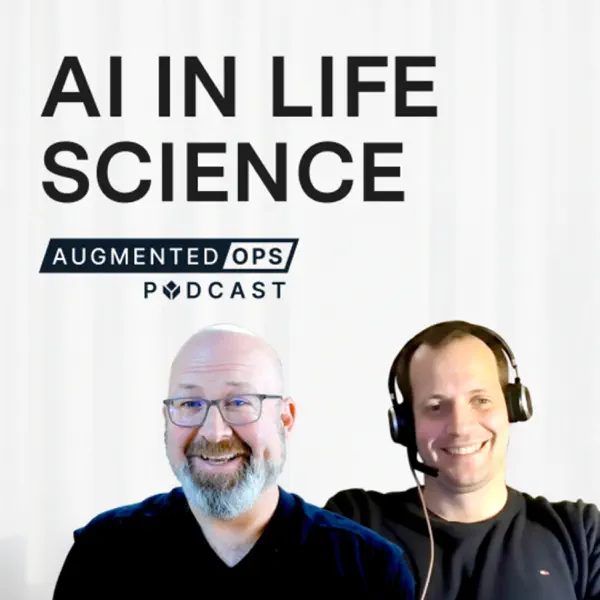

In a recent episode of the Augmented Ops podcast, two experts at the forefront of this balancing act — Brian Ennis, Chief Quality Officer and Co-founder at Swear, and Martin Hytman, a Business Mathematician and AI Expert in Life Sciences — shared their insights on navigating the crossroads of AI innovation and regulation.
The first key point? AI is not a monolith. “AI is not just one thing only,” Hytman emphasized. “It’s really a powerful set of tools where we have this range from traditional and analytical AI that still play, of course, a very important role — think about visual inspection, thinking about pattern recognition, finding irregularities and so on. But then this, of course, got a whole new game and nuance as we are now in this age of Generative AI.”
Those generative capabilities, from chat-based SOPs to root cause analysis to CAPA investigations, offer tantalizing potential. But they also demand a new level of vigilance and control.
“We all have these projects of, ‘Oh, our supplier now has this AI module, and we need to go for that because we want to have our first AI GXP use case implemented, we want to be first,'” Hytman said. “And of course, a natural reaction is resistance, at least for some, as there are new obligations, new responsibilities that are put upon my shoulders that I’m maybe not so comfortable with.”
What is this human oversight that I should actually apply? How can I spot hallucinations that are now automatically supposed to solve so that the system is still under control? What happens if I miss such a hallucination and we have a horrible implication on, in the end, the patient possibly?
For Ennis, the key is a proactive approach to designing AI systems for trust and transparency from the start, rather than trying to retroactively prove their safety.
“We’re in a reactive paradigm in current validation methodologies where we say, ‘Prove it’s safe before I use it,’ right?” he said. “Whereas you turn that around, you say, ‘Well, design it safely from the start.'”
Fear kills adoption faster than regulation does, right? I mean, that’s for sure. We see that. But we’re in a reactive paradigm in current validation methodologies where we say, ‘Prove it’s safe before I use it,’ right? Whereas you turn that around, you say, ‘Well, design it safely from the start,’ right? And then tell that story, and then you can grow with it and change it and monitor it and work with it.
Looking ahead, both Ennis and Hytman see a future where AI is increasingly woven into the fabric of life sciences — but not without some turbulence along the way. Ennis predicts a near-term focus on neural processer characters (NPCs) and software agents that can automate transactional tasks by ferrying data between legacy systems. But he also foresees an eventual reckoning as those legacy systems are disrupted by newer, AI-native tools.
Hytman, for his part, emphasizes the organizational transformation required to keep pace with the blistering speed of AI innovation. “The world will be full of surprises in AI in the next four or five years,” he said. “It’s not so much from my perspective as to how we can now adopt this specific technology. It’s more about a transformation journey. How can we establish the capabilities to go with the flow of innovation at that speed that we were observing in the last couple of years, that possibly may even accelerate?”
The key, both agree, is to start building the foundations now — the data infrastructures, the validation frameworks, the governance models — that will allow life sciences organizations to grow and evolve with AI, rather than being left behind by it.
“I think there will be those who will build those foundations that we are talking about — data, validation frameworks, governance, strategy, having this in place, growing the organization with all of these foundational elements and also growing with the use cases that are implemented under these foundations,” Hytman said. “And those that are still somewhere in this pilot or in the couple of use cases, up to the early adopter zone — the gap will be increasing.”
In other words, when it comes to AI in life sciences, the time to start balancing is now. The tightrope may be narrow, but the rewards for those who can walk it successfully are immense.
To hear Brian Ennis and Martin Hytman’s full conversation on AI in life sciences, check out the latest episode of the Augmented Ops podcast from Tulip Interfaces, available on LinkedIn, YouTube, or at tulip.co/podcast.